
Industry Insights
How to Make a DIY Packaging Box in the London UK
Aug
Product Specifications: DIY Packaging Box Guide
| Specification | Recommended option |
|---|---|
| Main material | Corrugated cardboard or sturdy folding carton board |
| Best for | Retail products, gifts, handmade goods, e-commerce orders and small business packaging |
| Box style | Tuck-end, mailer, sleeve, two-piece or simple folding box |
| Customisation | Size, shape, colour, print, logo, inserts and finishes |
| Suitable for | Lightweight to medium-weight products |
| Printing | Digital, lithographic or simple branded labels |
| Protection | Choose board thickness according to product weight and shipping conditions |
| Sustainability | Recyclable cardboard and paper-based materials are practical choices |
| Ideal location | London and UK businesses needing practical, branded packaging |
| Professional alternative | Bespoke packaging manufactured to your exact dimensions |
How to Make a DIY Packaging Box in the UK
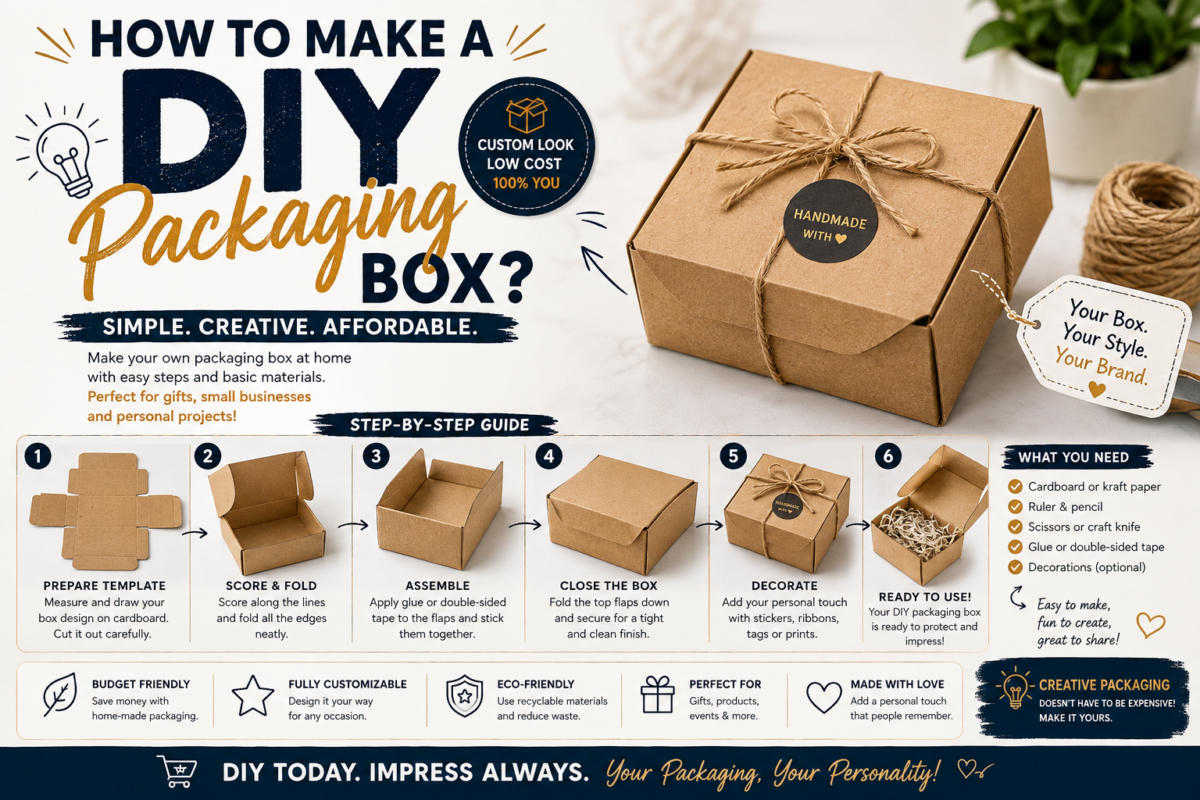
If you have ever wondered how to make a DIY packaging box for a product, gift, order or small business, the good news is that you do not need complicated machinery to get started. With the right cardboard, a ruler, pencil, scissors or craft knife and a little patience, you can create a simple box that fits your product much better than a standard-sized carton.
For businesses, the process becomes even more useful when you understand how packaging dimensions, board strength, folding points and branding work together. A well-planned box can protect the item inside while giving your customer a better unboxing experience.
If you are based in London and want to test your packaging idea before moving into professional production, exploring custom boxes london can give you useful inspiration for box styles, materials and finishes. CustomBoxes Azz provides packaging solutions for businesses that want to move from a basic DIY concept to professionally produced packaging.
When planning custom packaging boxes london uk, start with the product rather than the artwork. The box needs to fit the item properly first. Branding, colours and decorative details come afterwards.
What You Need to Make a DIY Packaging Box
A basic DIY box can be made with inexpensive materials, but the tools you use will affect the accuracy of the finished result.
You will usually need:
- Corrugated cardboard or suitable box board
- Pencil and ruler
- Measuring tape
- Craft knife or sharp scissors
- Cutting mat
- Paper glue or strong double-sided tape
- Bone folder or similar folding tool
- Printed artwork, stickers or labels if branding is required
For a quick prototype, ordinary clean cardboard can work well. However, if you are testing packaging for an actual product range, use a board that is reasonably close to the material you expect to order commercially.
This matters because a box made from thin paperboard may fold differently from a stronger corrugated board. If you eventually need shipping protection, you may find custom corrugated boxes more suitable than a lightweight DIY carton.
Step 1: Measure the Product Carefully
The first step in learning how to make a DIY packaging box is measuring the item correctly.
Measure the:
- Length
- Width
- Height
Write each measurement down before drawing the box template. Do not rely on approximate measurements, especially if the product is going to be sold online and shipped to customers.
You need enough internal space for the product to enter and leave the box without forcing it, but excessive empty space can cause movement during delivery.
A useful starting point is to allow a small amount of clearance around the product. If you are adding tissue paper, foam, cardboard inserts or another protective layer, measure the product together with that protection.
Choosing the Right Box Size
The ideal size depends on what you are packaging. A small box for jewellery needs a very different construction from a carton for clothing, food or a heavier retail product.
| Product type | Suggested packaging approach | Main consideration |
|---|---|---|
| Jewellery | Small folding or rigid box | Presentation and internal fit |
| Cosmetics | Folding carton or tuck-end box | Branding and product protection |
| Clothing | Mailer or folding carton | Easy opening and storage |
| Gifts | Decorative or rigid box | Appearance and presentation |
| Food | Food-safe board box | Hygiene and suitability for contents |
| E-commerce products | Corrugated mailer | Protection during delivery |
For food-related products, you should use materials and construction appropriate for the intended contents rather than simply copying a generic DIY box. Businesses selling takeaway products, for example, can look at dedicated food boxes for ideas about practical formats.
Step 2: Draw Your Box Template
Once you know the dimensions, draw the template on the cardboard.
A simple folding box normally consists of a central panel surrounded by side panels, folding flaps and glue tabs. The exact layout changes according to the style of box you want to create.
For a basic rectangular box, think of the template as a series of connected panels rather than trying to draw the complete three-dimensional box immediately.
Mark:
- Main front panel
- Back panel
- Left and right side panels
- Top and bottom flaps
- Glue tabs
- Folding lines
- Cutting lines
Use a pencil for the first version. This makes it easier to correct mistakes before cutting.
For custom packaging boxes london uk, professional dielines are normally created digitally so that every panel and fold is accurately positioned. That approach becomes particularly useful when you need several boxes to be identical.
Step 3: Cut the Cardboard
Place your cardboard on a suitable cutting surface and cut along the outer edges of your template.
If you are using a craft knife, take your time. Several light passes are generally easier to control than trying to cut through thick cardboard with excessive pressure in one movement.
Keep your fingers away from the cutting path and use a ruler as a guide where appropriate.
Do not cut the fold lines. These need to remain intact so the box can be folded into shape.
A clean cutting edge makes a surprising difference to the final appearance. Uneven edges can make a handmade prototype look untidy and can affect how accurately the panels meet.
Step 4: Score and Fold the Box
After cutting, score the areas that need to fold.
Scoring creates a controlled crease, making it easier to fold the board without damaging the surface. Fold each panel slowly along its scored line.
Try not to bend the cardboard backwards and forwards repeatedly. Excessive movement can weaken the crease and make the box look worn before it is even used.
For businesses considering custom boxes london, this stage is particularly useful during prototyping because it lets you identify whether the chosen dimensions actually work before committing to a production run.
Step 5: Assemble the Box
Apply adhesive to the appropriate glue tabs and bring the panels together.
Hold each section in place long enough for the adhesive to grip. Strong double-sided tape can be easier for prototypes because it is clean and does not require drying time.
Once the main structure is secure, fold the bottom and top flaps into position.
Check that:
- The corners are square
- The lid closes properly
- The product fits without excessive movement
- No adhesive touches the product
- The box can be opened without tearing
- The finished packaging looks neat from every side
If your prototype feels too loose, reduce the internal dimensions slightly. If the product is difficult to insert or remove, increase the clearance.
Material Choice Matters More Than You Might Think
Cardboard is not one single material. Different grades and thicknesses provide different levels of stiffness, crush resistance and protection.
| Material | Typical use | Strength | Suitable for DIY prototype |
|---|---|---|---|
| Lightweight paperboard | Small retail cartons | Low–medium | Yes |
| Folding carton board | Retail and presentation packaging | Medium | Yes |
| Corrugated board | Delivery and shipping boxes | Medium–high | Yes |
| Heavy rigid board | Premium presentation boxes | High | More difficult |
| Recycled board | General packaging applications | Varies | Yes |
If your product is going through a courier network, think beyond how the box looks on your desk. Parcels can experience stacking, handling, movement and pressure during transport.
That is why custom packaging boxes london uk should be designed around the actual use of the packaging, not simply its appearance.
DIY Packaging or Professionally Made Boxes?
Making one or two boxes yourself is a useful way to understand the design process. It helps you test dimensions, opening mechanisms and presentation before placing an order.
However, DIY construction becomes less practical when you need dozens, hundreds or thousands of identical boxes.
| DIY packaging | Professionally made packaging |
|---|---|
| Good for prototypes | Better for production quantities |
| Low initial cost | Consistent finished quality |
| Handmade cutting and folding | Accurate machinery and dielines |
| Limited printing options | Professional branding available |
| Useful for testing | Better suited to repeat orders |
| Time-consuming at scale | More efficient for larger quantities |
If you have already tested your design and want a cleaner commercial result, custom box packaging can help bridge the gap between a handmade prototype and production-ready packaging.
CustomBoxes Azz can be considered when you need packaging made around the exact dimensions, presentation and practical requirements of your product.
Creating Better Packaging for London Customers
When designing custom packaging boxes london uk, consider how your customer will actually interact with the packaging.
For an e-commerce brand, the first experience may happen when the parcel arrives at the customer’s home. For a shop, the box may sit on a shelf beside competing products. For a gift business, presentation could be the main reason someone chooses one package over another.
This is where small details become useful:
- A correctly sized box can reduce unnecessary movement.
- A strong closure can make the package easier to handle.
- A printed logo can make the packaging more recognisable.
- A suitable insert can keep products positioned correctly.
- A carefully chosen colour scheme can reinforce your brand identity.
- A recyclable board can support a more responsible packaging approach.
If you want to add branding without immediately moving to fully printed packaging, custom boxes with logo UK can be another option to explore.
For very small businesses, branded stickers can be a practical starting point too. CustomBoxes Azz offers stickers that can be used to add branding to plain packaging while you test your product range and packaging requirements.
From a DIY Prototype to Custom Packaging Boxes London UK
A DIY box is more than a craft project when you are developing packaging for a business. It gives you the chance to test your dimensions, product fit, opening experience and material choice before investing in a finished design.
Once you know what works, you can move towards custom packaging boxes london uk that are manufactured to your preferred measurements and brand requirements.
For London businesses, this approach can save time because you are not guessing what your finished box should look like. You have already tested the concept in your hands.
The next stage is to refine the design, choose the right construction and decide whether you need printing, inserts, special finishes or stronger board. That is where a well-planned packaging specification becomes especially valuable.
Turning Your DIY Box Design into Professional Packaging in London
Once you have created and tested your prototype, the next step is deciding whether your packaging is ready for professional production. A DIY sample gives you a useful starting point, but commercial packaging needs to be consistent, durable and suitable for repeated use.
For businesses searching for custom boxes London, the key is to move from a rough handmade template to a properly measured packaging specification. Your final box should be designed around the product, the way it will be handled and the type of customer experience you want to create.
CustomBoxes Azz can help businesses move beyond basic prototypes towards custom box packaging London designed for specific products and branding requirements.
How to Make a DIY Packaging Box That Looks Professional
Learning how to make a DIY packaging box is relatively straightforward, but making one that looks professionally produced requires more attention to detail.
Look closely at the sample you have made. Ask yourself:
- Does the product sit securely inside?
- Are the corners straight?
- Does the lid close properly?
- Is the cardboard strong enough?
- Can the box survive normal handling?
- Is there enough room for protective material?
- Does the opening experience feel right?
- Could the design be produced repeatedly without variation?
If the answer to any of these questions is no, adjust the prototype before finalising your design.
This testing stage is particularly valuable for custom packaging boxes London UK because a small change in panel width or flap depth can make a noticeable difference once the box is manufactured in quantity.
Choosing the Right Box Style in London
There is no single box style that works for every product. Your choice should reflect the product dimensions, opening method, storage requirements, shipping conditions and brand positioning.
A small retailer may want a simple folding carton, while a premium gift business may prefer a rigid construction. An online seller might need a stronger mailer that can handle courier delivery.
| Box style | Best suited to | Main advantage | London business example |
|---|---|---|---|
| Tuck-end box | Retail products | Simple opening and closing | Cosmetics or small products |
| Mailer box | E-commerce | Good delivery presentation | Online retailers |
| Two-piece box | Gifts and premium items | Premium appearance | Gift businesses |
| Rigid box | Luxury products | Strong and substantial | Jewellery or premium goods |
| Corrugated box | Shipping | Increased protection | E-commerce orders |
| Food box | Takeaway and food products | Designed for food applications | Cafés and food businesses |
Businesses looking for custom boxes London should consider how customers will open and reuse or dispose of the packaging, rather than choosing a style based solely on appearance.
Request a Quote
DIY Packaging Box Dimensions: Getting the Measurements Right
Incorrect dimensions are one of the most common problems when creating packaging from scratch.
Your internal dimensions should be based on the product itself. If you are adding an insert, tissue paper or protective padding, include that space in your calculations.
A useful way to plan your box is to separate the measurements into internal and external dimensions.
| Measurement | What it means | Why it matters |
|---|---|---|
| Internal length | Available space inside the box | Determines product fit |
| Internal width | Side-to-side space | Prevents excessive movement |
| Internal height | Vertical space | Allows the product to sit correctly |
| Board thickness | Thickness of packaging material | Affects final external size |
| External dimensions | Overall finished box size | Useful for shipping and storage |
Do not assume that a box measuring 200 mm externally will provide exactly 200 mm of internal space. Board thickness, folds and construction all affect the final result.
This is one reason professional custom packaging boxes London UK should be specified using accurate product measurements rather than rough estimates.
Selecting Cardboard Strength for London Delivery
If your box will remain inside a shop, the material requirements may be relatively simple. If it will be sent through a courier network, you need to think more carefully about strength.
A shipping box may be exposed to pressure from other parcels, repeated handling and movement during transportation. A box that looks strong on a workbench may not provide enough protection when it is packed into a delivery vehicle.
For businesses in London sending orders across the UK, corrugated board is often worth considering where additional protection is required. You can explore custom corrugated boxes London when your packaging needs to balance branding with practical delivery protection.
Comparing Board Options
| Board type | Appearance | Protection | Typical application |
|---|---|---|---|
| Folding carton board | Smooth | Moderate | Retail packaging |
| Single-wall corrugated | Practical | Good | E-commerce shipping |
| Double-wall corrugated | Industrial | Very good | Heavier products |
| Rigid board | Premium | High | Luxury presentation |
| Recycled board | Natural | Varies | Eco-conscious packaging |
The best material depends on the product rather than simply choosing the thickest board available.
Adding Your Brand to DIY Packaging
Once the structural design works, you can start thinking about branding.
Your packaging may be the first physical part of your brand that a customer handles. A plain box can protect a product, but branded packaging can make the order feel more considered.
You can add:
- Your company logo
- Brand colours
- Product information
- Website details
- Care instructions
- Recycling information
- Promotional messages
- Social media details
If you want printed branding incorporated directly into the packaging, custom boxes with logo London UK can be considered for a more consistent appearance.
For a smaller run or a business still testing designs, branded stickers can be useful. Custom stickers London allow you to apply branding to plain cartons without redesigning the entire box.
This can be particularly useful if your product range changes frequently.
When to Choose Bespoke Boxes in London
A DIY prototype works well when you are experimenting. A bespoke box becomes more useful when the dimensions, construction and branding have been established.
For example, imagine you sell handmade candles. A standard box might leave too much empty space around the candle, increasing movement during delivery. A bespoke design can be built around the exact dimensions of the candle and any protective insert.
Businesses exploring bespoke boxes London can use this approach to create packaging that is designed specifically around their product rather than forcing their product into a generic carton.
The same principle applies to premium products. If presentation is a major part of your customer experience, rigid boxes London can provide a more substantial packaging format.
DIY Box vs Bespoke Box
| Requirement | DIY box | Bespoke London box |
|---|---|---|
| Prototype testing | Excellent | Usually unnecessary |
| One-off project | Suitable | May not be required |
| Consistent production | Difficult | Excellent |
| Professional printing | Limited | Available |
| Exact dimensions | Possible | Designed precisely |
| Large quantities | Time-consuming | More practical |
| Premium presentation | Limited | Wide range of options |
Packaging for Different London Industries
Different industries need different packaging solutions. A bakery does not have the same requirements as a cosmetics company, and an online clothing shop has different priorities from a gift retailer.
For food businesses, packaging needs to suit the type of food, handling conditions and presentation requirements. Custom food boxes London can be useful when a business needs packaging designed around its food products.
Pizza businesses may need a ventilated format with enough structural strength for delivery. Dedicated pizza boxes London are designed around this particular application rather than adapting a generic carton.
For drinks and food-service businesses, packaging may extend beyond boxes. Businesses can explore coffee cups London UK when branded takeaway drinks are part of the customer experience.
The important lesson is simple: packaging should reflect the product.
Designing Packaging for E-Commerce in London
Online businesses need to think about packaging from the moment an order is picked to the moment the customer opens it.
A good e-commerce package should ideally be:
- Easy for staff to assemble
- Secure when closed
- Suitable for courier handling
- Efficient to store
- Appropriate for the product
- Easy for the customer to open
- Presentable when delivered
If the box is unnecessarily large, you may be using more material than necessary and leaving the product with too much room to move. If it is too small, the product may be difficult to pack or could become damaged.
This is why custom delivery boxes London can be a practical option for businesses that have already identified their ideal packaging dimensions.
Testing Your DIY Packaging Before Ordering
Before sending your final specification to a packaging manufacturer, test the prototype several times.
Put the actual product inside it. Close the box. Open it again. Repeat the process.
Then consider what happens if the box is transported.
You can test:
- Product fit
- Closure strength
- Corner stability
- Internal movement
- Ease of opening
- Storage efficiency
- Branding visibility
- Protection around fragile areas
You should make changes based on what you observe rather than what you originally expected.
A prototype is there to expose weaknesses before production.
Sustainable Packaging Choices for London Businesses
Sustainability is increasingly part of packaging decisions, but the most suitable option still depends on the product and application.
Cardboard and paper-based packaging can be practical because they are widely used in packaging systems and can often be recycled where local facilities accept the relevant material.
You can make your packaging more efficient by avoiding unnecessary layers, excessive empty space and oversized cartons.
For example, a smaller correctly fitted box may require less material than a large box filled with unnecessary protective material.
If your packaging needs to communicate a more premium identity while remaining practical, bespoke packaging London UK gives you greater control over dimensions, construction and presentation.
Why Local Packaging Planning Can Help
For a London business, packaging development is often connected to much more than the box itself. You may need to think about storage, delivery, branding, product photography and the customer’s unboxing experience at the same time.
This is where working with a packaging specialist can make the process easier.
Instead of explaining your requirements from scratch every time, you can provide your tested prototype, product measurements and preferred material. The packaging supplier can then use that information as the foundation for the finished design.
Businesses searching for custom packaging London can use this process to turn an initial DIY idea into packaging that is repeatable and commercially practical.
CustomBoxes Azz can be part of that transition, particularly when you already know the basic dimensions and style you want.
Other Packaging Options You May Need
Your packaging strategy may eventually include more than one type of box.
A retailer could use a printed carton for its main product, a rigid box for premium collections and a corrugated carton for shipping. A food business might combine food boxes with printed cups and branded labels.
For specialist products, dedicated formats may be more suitable. For example, businesses looking for gift boxes London can choose packaging designed around presentation, while brands requiring specialist tobacco packaging can explore cigarette boxes London.
Similarly, businesses needing plastic packaging may find plastic bottles London or PET plastic bottles London more appropriate than cardboard.
The goal is not to use one packaging format for everything. The goal is to choose the format that makes sense for each product.
A Practical Final Checklist for Your DIY Packaging Box
Before moving from DIY testing to professional production, run through this checklist:
- Measure the product again.
- Confirm internal box dimensions.
- Check board thickness.
- Test the closing mechanism.
- Test the box with the real product.
- Add protective material if required.
- Check whether the packaging can withstand delivery.
- Review the printed artwork.
- Check logo positioning.
- Consider storage space.
- Think about recycling and material efficiency.
- Confirm how many boxes you actually need.
- Compare DIY production time with professional manufacturing.
If the design passes these checks, you are in a much stronger position to order custom boxes London UK for regular business use.
From DIY Design to Custom Packaging Boxes London UK
The process of learning how to make a DIY packaging box gives you something valuable: a practical understanding of how your packaging should work.
You learn where the folds need to go, how much space your product needs, what type of material feels appropriate and how the box performs when assembled.
Once those details are tested, professional production becomes much easier because you are no longer starting with a vague idea.
For London brands, custom packaging boxes London UK can provide a route from prototype to professionally made packaging. Whether you need simple printed cartons, protective shipping boxes, premium presentation packaging or product-specific designs, the right specification should always begin with your product.
The strongest packaging is not necessarily the most complicated. It is packaging that fits properly, protects what is inside, looks right for the brand and works reliably every time.
If you are still refining your first design, start with a simple prototype. Measure carefully, test the construction and make changes based on real use. Once the design works, you can move towards custom boxes London and create a more consistent packaging solution for your customers.
For growing businesses, that transition can turn a simple DIY experiment into a professional packaging system that is easier to reproduce, easier to brand and better suited to everyday business use.
Final Guide to DIY Packaging Boxes for London Businesses
How to Make a DIY Packaging Box: Final Design and Production Guide for London
Once your prototype has been tested, the next stage is turning your DIY concept into packaging that works consistently for your business. Learning how to make a DIY packaging box is useful because it gives you direct control over dimensions, materials, folding points and presentation before you commit to a larger production order.
For businesses looking for custom packaging boxes London UK, this testing process can make professional production much easier. You already know what fits, where the folds need to be and how the finished box should open.
CustomBoxes Azz can then help you move from a handmade sample towards a more consistent commercial packaging solution.
Product Specification Checklist for London Packaging
Before ordering professionally manufactured packaging, prepare a clear specification. This helps avoid confusion and gives your packaging supplier the information needed to produce the right box.
| Specification | What to decide | London business consideration |
|---|---|---|
| Product dimensions | Length, width and height | Measure the actual product |
| Box dimensions | Internal and external size | Consider storage and delivery |
| Material | Paperboard, corrugated or rigid board | Match strength to product weight |
| Box style | Mailer, tuck-end, rigid or other format | Choose according to customer use |
| Printing | One-colour or full-colour artwork | Keep branding consistent |
| Finish | Matte, gloss or specialist finish | Match the desired presentation |
| Closure | Tuck flap, magnetic, adhesive or other | Make opening convenient |
| Inserts | Cardboard, paper or protective support | Useful for fragile products |
| Quantity | Required production volume | Consider current and future demand |
| Delivery | Local or nationwide shipping | Select suitable board strength |
Having this information ready means you can explain your requirements clearly rather than simply saying you need a “small box” or “strong packaging”.
How to Make a DIY Packaging Box With the Right Dieline
A dieline is essentially the flat blueprint of your packaging. It shows where the material is cut and where it folds.
For a simple DIY box, you can draw the dieline manually. For professional packaging, the design is normally created digitally so measurements can be reproduced accurately.
Your dieline should clearly distinguish between:
- Cutting lines
- Folding lines
- Glue areas
- Front panels
- Back panels
- Side panels
- Top flaps
- Bottom flaps
- Insert positions
Do not place important artwork directly over a fold or cutting area. Give your design enough safe space so that slight production tolerances do not affect your logo or product information.
When developing custom box packaging London, a properly prepared dieline is particularly helpful because it connects the creative design with the physical construction of the box.
Why a Prototype Should Be Made First
A prototype is not wasted time. It is a practical test.
You may discover that a lid is too tight, an opening tab is too small or a product moves around inside the box. These are much easier to fix before commercial production.
For custom boxes London, testing is especially useful when the packaging has several folding panels or an unusual shape.
Try the prototype with the actual product rather than a similar-sized substitute. Even a small difference in product shape can affect the final fit.
Choosing Between Folding Cartons, Corrugated and Rigid Boxes
The right material depends heavily on what your packaging needs to do.
A folding carton may be ideal for a lightweight retail product. Corrugated board is generally more appropriate when the package needs additional protection during shipping. Rigid packaging can be suitable when premium presentation is a major part of the product experience.
| Packaging type | Best for | Key benefit | Consider before choosing |
|---|---|---|---|
| Folding carton | Retail products | Lightweight and printable | May not suit heavy products |
| Corrugated box | E-commerce and delivery | Stronger protection | Can look more functional |
| Rigid box | Premium products | High-end presentation | More substantial construction |
| Gift box | Gifts and presentation | Attractive opening experience | Depends on product dimensions |
| Food box | Food products | Designed for food applications | Material suitability is essential |
If you are developing premium packaging, rigid boxes London may offer a better starting point than a basic folding carton.
For products that need protection during courier delivery, corrugated boxes London can be a more practical direction.
Making Your DIY Box More Brand-Focused
A box does not have to be covered in graphics to look professional. In many cases, simple branding works better.
Consider where your logo should appear first. The most visible panel is often the obvious choice, but you can create a more refined appearance by using smaller branding on the inside flap or side panel.
For businesses developing custom boxes with logo London UK, think about the complete opening experience.
For example:
- The customer receives the parcel.
- They see the outer packaging.
- They open the box.
- The product is revealed.
- They see your logo or message.
- They remove the product.
- They can dispose of or reuse the packaging.
Every stage is an opportunity to make the packaging feel intentional.
Using Stickers With DIY Packaging
If you are not ready to order fully printed boxes, stickers can be a flexible alternative.
Plain cardboard boxes can be branded with a logo sticker, product label or seasonal message. This is particularly useful for small London businesses that have several products and do not want to keep separate printed box designs for every item.
CustomBoxes Azz offers custom stickers London that can complement a DIY or professionally manufactured box.
A sticker can also make it easier to update your branding. For example, you could use the same plain carton for several products and apply a different label to each product.
Packaging for Food and Hospitality Businesses in London
Food packaging needs to be approached differently from general retail packaging.
The packaging should suit the food, handling conditions and intended use. It should not simply be selected because it looks attractive.
For restaurants, cafés and food-delivery businesses, food boxes London can provide a more relevant starting point than adapting a standard retail carton.
Pizza businesses have their own requirements, including suitable dimensions, practical opening and delivery considerations. Dedicated pizza boxes London can therefore be more appropriate for takeaway pizza than a generic DIY box.
Coffee shops and takeaway businesses may need complementary packaging too. coffee cups London UK can be considered when the packaging system includes branded drinks as well as food.
Packaging for Gifts and Premium Products
If the purpose of the packaging is to create a strong presentation, construction and finish become just as important as protection.
Gift packaging can be used for:
- Corporate gifts
- Jewellery
- Beauty products
- Seasonal products
- Luxury accessories
- Special occasions
- Subscription products
For these applications, gift boxes London can offer a more presentation-focused approach.
A rigid construction may be useful where the customer is expected to keep the box after opening. In that situation, the packaging becomes part of the perceived value of the product rather than simply a disposable container.
Specialist Packaging Requirements in London
Not every product belongs in a standard rectangular carton.
Some businesses need specialist packaging designed around a particular product category. The most effective approach is to identify the product’s physical requirements first and then choose the appropriate packaging format.
For example, businesses requiring specialist cigarette packaging can explore cigarette boxes London or cigarette packaging boxes London.
Businesses that package liquids may have different requirements altogether. In those cases, plastic bottle supplier London or PET plastic bottles London may be more appropriate than a cardboard-only solution.
The wider lesson is that packaging should be designed around the product rather than forcing every product into the same box format.
Choosing the Right Packaging Quantity
The quantity you order should reflect your sales volume, available storage and expected growth.
Ordering too many boxes can create unnecessary storage problems, while ordering too few can mean repeatedly arranging small production runs.
| Business stage | Packaging approach |
|---|---|
| Testing a new product | DIY prototype or small packaging run |
| Early sales | Simple branded packaging |
| Growing business | Consistent custom packaging |
| Established product | Larger repeat production |
| Multiple product ranges | Several size-specific box designs |
If you are still testing your product, make the packaging specification flexible. Once your sales pattern becomes clearer, you can move towards a more established bespoke boxes London solution.
Packaging Storage for London Businesses
Storage is often overlooked when designing a box.
A packaging design might work perfectly from a product perspective but become difficult to manage if the finished boxes take up too much warehouse or shop space.
Consider:
- Flat-packed versus pre-assembled packaging
- Number of boxes stored at one time
- Carton dimensions
- Shelf space
- Moisture exposure
- Accessibility for staff
- How quickly stock is used
Flat-packed packaging can be useful because it occupies less space before assembly. However, your team needs to be comfortable assembling it efficiently.
For growing businesses, custom packaging London should be considered alongside your storage and fulfilment process rather than as a separate issue.
Delivery Testing for Custom Boxes London
A box that looks perfect when assembled in your office still needs to perform during delivery.
Place your actual product inside the prototype and close it as you would for a customer order. Consider how it will be handled, stacked and transported.
You should check whether:
- The product shifts inside.
- The lid can open accidentally.
- Corners collapse under pressure.
- The material creases too easily.
- Internal protection stays in position.
- Labels remain visible.
- The finished parcel is practical to handle.
For businesses sending orders throughout London and the rest of the UK, custom delivery boxes London can be developed around the practical requirements of e-commerce fulfilment.
Why Custom Boxes London Can Be Better Than Generic Packaging
Generic packaging is convenient, but it may not fit your product particularly well.
You might have to add excess tissue, bubble wrap or other filling simply because the carton is larger than the item. Alternatively, you may have to squeeze the product into a box that is slightly too small.
With custom boxes London, the packaging can be planned around the product dimensions from the beginning.
That can make the packaging process simpler for your staff and create a cleaner presentation for the customer.
Custom packaging can be especially useful when you sell products in different sizes. Instead of one oversized box for everything, you can create packaging sizes that correspond with your product range.
Building a Consistent Packaging Range
Once one DIY box has been successfully developed, you can use the same design principles for your wider product range.
For example, a cosmetics business might develop:
- Small boxes for individual products
- Medium boxes for product bundles
- Larger boxes for gift sets
- Corrugated delivery boxes for online orders
This creates visual consistency without requiring every package to be exactly the same.
A consistent packaging family can use the same colours, typography and logo placement while adapting the dimensions to each product.
For businesses developing bespoke packaging London, this is a useful way to build a recognisable packaging system rather than ordering unrelated boxes for individual products.
What Makes a Good DIY Packaging Box?
A successful DIY box does not need to be complicated.
It needs to do its job well.
The best design normally balances five things:
- Fit — the product should sit securely.
- Strength — the board should suit the product and delivery method.
- Function — the box should be easy to assemble and open.
- Presentation — the packaging should reflect your brand.
- Efficiency — the design should avoid unnecessary material and space.
If one of these areas is ignored, the packaging can become frustrating for either your team or your customer.
Final Specification Before Professional Production
Before approving a finished packaging design, prepare one final specification sheet.
| Final detail | Confirmed requirement |
|---|---|
| Product | Exact product name |
| Internal dimensions | Length × width × height |
| Material | Board type and thickness |
| Construction | Selected box style |
| Artwork | Final approved design |
| Branding | Logo and brand colours |
| Finish | Required surface finish |
| Inserts | Required or not required |
| Quantity | Initial production quantity |
| Delivery | Required delivery arrangement |
| Testing | Prototype approved |
| Supplier | Selected packaging manufacturer |
Keep a copy of this information so that future orders can be compared with the original specification.
How to Make a DIY Packaging Box and Know When to Stop DIY
There is a point where DIY packaging has done its job.
If you are making a handful of boxes for personal use, continuing with handmade construction may be perfectly reasonable. If you are fulfilling regular customer orders, manually cutting and folding every box can quickly become inefficient.
The purpose of learning how to make a DIY packaging box is not necessarily to manufacture every future box yourself. It is to understand the packaging you need.
Once you know the correct dimensions, material, construction and branding requirements, professional manufacturing becomes a logical next step.
For businesses that have reached that stage, custom packaging boxes London UK can provide a route towards repeatable packaging that looks consistent from one order to the next.
Choosing CustomBoxes Azz for Your London Packaging Project
CustomBoxes Azz can be considered when you want to turn a packaging concept into a finished product.
The useful starting point is your own prototype and product measurements. Explain what you liked about the DIY version, what did not work and what you want to improve.
You may need a stronger board, a different closure, better printing, a smaller footprint or a more premium finish.
The more specific your requirements are, the easier it becomes to develop packaging that matches your actual needs.
Whether you need custom packaging boxes London UK, custom boxes London UK, custom corrugated boxes London or premium bespoke boxes UK London, the process should begin with accurate measurements and practical testing.
Final Thoughts on DIY Packaging Boxes in London
Learning how to make a DIY packaging box is a useful first step for anyone developing packaging for a product, online shop or growing London business.
Start with accurate measurements. Choose a suitable board. Draw your dieline carefully. Cut and score the material cleanly. Assemble the prototype and test it with the actual product.
Then look beyond the box itself.
Think about your customer’s first impression, how the parcel will travel, where the packaging will be stored and how your team will assemble or fulfil orders.
When the prototype works, you can move towards professionally produced custom boxes London that are consistent, branded and designed around your product.
For businesses that want a wider packaging solution, custom boxes and packaging London can become part of a complete brand experience rather than simply a container for the product.
The most effective packaging is usually the packaging that solves a real problem. It fits the product, protects it, looks appropriate for the brand and makes the customer’s experience easier.
If your DIY prototype achieves those goals, you have already completed the most important part of the packaging development process. The next step is simply refining that successful concept into reliable commercial packaging.
Final Product Specification Summary
| Area | Recommended approach |
|---|---|
| Prototype | Make a full-size sample first |
| Measurements | Use the actual product |
| Board | Select according to product weight and delivery |
| Construction | Choose the simplest suitable box style |
| Branding | Use consistent logo, colours and artwork |
| Protection | Add inserts where genuinely needed |
| Shipping | Test the packed box before production |
| Sustainability | Avoid unnecessary material and empty space |
| Production | Move to professional manufacturing once tested |
| London focus | Choose packaging suitable for your customers and fulfilment needs |
London Packaging Planning Checklist
Before placing an order, make sure you have:
- Exact product measurements
- Final internal box dimensions
- Suitable board specification
- Approved box construction
- Final artwork
- Logo positioning
- Required finish
- Insert requirements
- Required quantity
- Storage plan
- Delivery requirements
- Tested prototype
- Final packaging approval
A carefully tested prototype gives you a much stronger starting point than ordering a generic box and hoping it works. Whether you are launching a new product or improving existing packaging, custom packaging boxes London UK can help turn the concept into a more polished packaging solution.
How do you make a DIY packaging box at home?
To make a DIY packaging box at home, start by measuring the product you want to package. Record the length, width and height, then decide how much extra room you need for tissue paper, an insert or other protection. Draw your box template on suitable cardboard, marking the cutting lines, folding lines and glue tabs. Carefully cut the template, score the fold lines and assemble the panels with strong adhesive or double-sided tape. For a simple prototype, this method works well because you can change the dimensions quickly if the product does not fit correctly.
If you are developing packaging for a London business, making a sample first can save you from ordering the wrong size. Once your design has been tested, you can move to custom boxes London for a more consistent commercial version. If your product needs stronger protection for delivery, corrugated boxes London may be worth considering. For branded presentation, you can explore custom boxes with logo London UK. The DIY stage is mainly about testing your idea before moving into repeat production.
What cardboard is best for making a packaging box?
The best cardboard depends on what you are putting inside the box and how the package will be handled. Lightweight paperboard can work well for small retail products, while thicker folding carton board offers more stiffness for presentation packaging. If your box will be posted or delivered by courier, corrugated cardboard is usually a more practical choice because its fluted structure provides additional protection compared with a simple flat sheet of board.
For a DIY prototype, choose a material that is reasonably close to the material you expect to use for the finished packaging. This helps you understand how easily the box folds, how strong the corners feel and whether the product stays secure. If you need delivery-focused packaging, you can look at custom corrugated boxes London as a professional alternative. For premium products, rigid boxes London may be more suitable. The important thing is to match the material to the product rather than simply choosing the thickest cardboard available.
How do you measure a box for custom packaging?
Measure your product first rather than guessing the finished box size. For a rectangular product, record the length, width and height in the same unit, such as millimetres or centimetres. Then decide whether you need space for protective material, an insert, tissue paper or another internal component. Your required internal box dimensions should provide enough room for the product without leaving excessive empty space.
You should normally distinguish between internal and external dimensions. Internal measurements tell you whether the product will fit, while external measurements matter when you are considering shipping, storage and the overall footprint of the finished package. Double-check every measurement before sending the specification to a supplier.
For businesses developing custom packaging boxes London UK, accurate measurements make the production process much easier. If you need packaging designed specifically around a product, bespoke boxes London can provide a more tailored solution. A carefully measured prototype is always a better starting point than ordering a generic box and trying to make the product fit afterwards.
What size box should I use for shipping products?
The right shipping box is the smallest practical size that protects your product without forcing it into the packaging. Start with the packed product rather than just the bare product. If you need bubble wrap, paper, cardboard inserts or another protective layer, include that when deciding your internal dimensions. A box that is too tight can damage the product or make packing difficult, while a box that is too large can allow excessive movement and require more filling.
For an online business, it can be useful to identify your most common order types and create a small range of box sizes rather than using one carton for everything. If you ship products around London and the wider UK, custom delivery boxes London can be developed around your products and fulfilment process.
For stronger shipping protection, custom corrugated boxes London are worth exploring. If presentation is equally important, you can combine protective outer packaging with branded inner packaging. The best size is the one that balances product protection, packing speed, storage and delivery requirements.
Are custom boxes worth it for a small business in London?
Custom boxes can be worthwhile for a small business when packaging is an important part of the customer experience. You do not necessarily need an elaborate design. A correctly sized box with your logo, colours and a clean finish can make your orders feel more professional and consistent. Custom sizing can be useful too because you are not relying on a generic carton that leaves too much empty space around the product.
Before ordering, work out how frequently you use the packaging and whether your product dimensions are stable. If you are still testing a product, make a DIY prototype first. Once the design is proven, custom packaging London can give you a more consistent solution.
For smaller brands, branded labels or stickers can be a flexible starting point. You can use custom stickers London on plain boxes while you test different packaging ideas. When your product range grows, you can move towards custom packaging boxes London UK with printed branding and product-specific dimensions.
How can I make a cardboard box stronger?
You can make a cardboard box stronger by choosing a suitable board grade, reinforcing weak areas and making sure the dimensions are appropriate for the product. The box should not be unnecessarily large because excessive empty space allows the contents to move around. You can add internal cardboard dividers, inserts or protective material where the product needs extra support.
The construction also matters. Clean folds and properly secured glue tabs help the box hold its intended shape. If you are making a DIY prototype, score the fold lines rather than repeatedly bending the cardboard back and forth. For heavier or regularly shipped products, a stronger corrugated construction may be more suitable than ordinary craft cardboard.
Businesses that need stronger shipping packaging can explore corrugated boxes London and select a construction based on the weight and handling requirements of the product. For premium items that need both strength and presentation, rigid boxes London are another option. The goal is not simply to make the thickest box possible. Good packaging uses the right material and construction for the actual product.
How do I design a box with my logo?
Start by creating the physical box design before finalising the artwork. Once you know the exact dimensions and panel layout, decide where your logo should appear. The front or top panel is often the most visible area, but you can use the side panels, inner lid or other surfaces if you want a more understated look. Keep important text away from folds, cutting lines and edges.
Your colours should match the rest of your brand so that the packaging feels connected to your website, labels and other marketing materials. Before production, check the artwork at the actual size of the finished box rather than viewing it only on a computer screen.
If you want professionally branded packaging, custom boxes with logo London UK can be used for product-specific packaging. If you are still experimenting, custom stickers London can give you more flexibility. This lets you test your branding on packaging without committing to a separate printed box for every product variation.
What type of packaging is best for e-commerce businesses?
The best e-commerce packaging depends on the product, how fragile it is and how it will be delivered. A lightweight product may work well in a folding carton or mailer-style box, while heavier or fragile products may need corrugated packaging and internal protection. Your box should be easy for your team to pack, secure enough for delivery and simple for your customer to open.
Try to avoid using one oversized box for every order. Different product sizes often need different packaging dimensions. You can start by identifying your most common products and order combinations, then create a small selection of box sizes around those orders.
For businesses serving London customers, custom delivery boxes London can be planned around your fulfilment requirements. custom packaging boxes London UK can add consistent branding to the delivery experience, while custom corrugated boxes London may provide a better option where shipping protection is the main concern. Always test a packed prototype before committing to a large production run.
What is the difference between custom boxes and bespoke boxes?
The terms are often used in similar ways, but the practical difference usually comes down to how much of the packaging is tailored to your requirements. A custom box may involve selecting a box style, size, material and printing options to suit your product. A bespoke box generally suggests a more individually designed solution where the structure, dimensions or features are developed specifically around your product.
For example, a standard folding carton with your chosen size and logo could be a suitable custom option. A completely unusual box shape with a specialist insert and specific opening mechanism would be closer to a bespoke solution.
If you want packaging designed around your exact product, bespoke boxes London are worth considering. For a wider range of packaging options, custom boxes London can be a practical starting point. Premium brands may also consider rigid boxes London where presentation and structure are major priorities. The right choice depends on your product, budget, quantity and desired customer experience.
How can I make packaging more sustainable?
Start by using the right amount of material rather than simply adding more layers. A box that is correctly sized around your product can reduce unnecessary empty space and the need for excessive filling. Choose packaging materials that suit the product while avoiding complicated combinations of materials when a simpler construction will do the job.
You should think about the entire packaging system too. A branded cardboard box, paper insert and paper-based label may be easier to handle than a mixture of several unnecessary materials. At the same time, packaging still needs to protect the product properly. Reducing material should not mean creating a package that arrives damaged.
If you are developing sustainable packaging for a London business, custom packaging London can be planned around your product dimensions and practical requirements. custom corrugated boxes London can be useful when you need stronger paper-based shipping protection. You can add branding through custom stickers London if you want flexibility while developing your packaging range. The best approach is to reduce unnecessary material while keeping the product properly protected.
