
Industry Insights
How To Measure Box Dimensions Before Making and Shipping It?
May
When you are creating packaging for products, gifts, retail items, or shipping purposes, getting the box dimensions right can save you time, money, and frustration. A box that is too small can damage your products. A box that is too large can increase shipping costs and waste packaging materials.
Whether you run an online shop, a retail business, or simply want better packaging for personal use, understanding how to measure box dimensions correctly is essential. This guide explains everything in simple terms so you can confidently measure boxes before manufacturing or shipping them.
Businesses across the UK often invest in custom boxes UK solutions to ensure products fit securely while maintaining a professional appearance. Proper measurements are the first step toward creating packaging that protects your items and improves customer experience.
Why Accurate Box Measurements Matter
Many people assume box measuring is straightforward until they encounter problems like:
- Products not fitting properly
- Higher courier charges
- Damaged items during transit
- Poor shelf presentation
- Wasted packaging materials
- Increased production costs
Correct box dimensions help you:
- Reduce packaging waste
- Lower shipping expenses
- Improve product protection
- Create better branding
- Improve storage efficiency
- Deliver a better unboxing experience
For businesses using custom packaging boxes UK, accurate measurements also help maintain consistency across all packaging orders.
Understanding the Three Main Box Dimensions
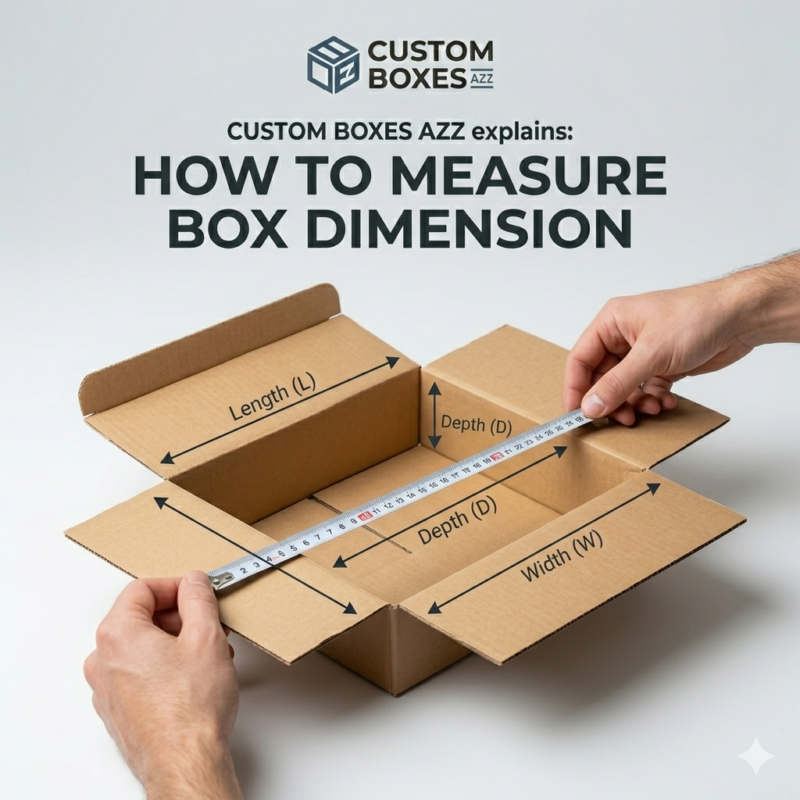
Every box is measured using three dimensions:
| Dimension | Meaning | Example |
|---|---|---|
| Length | Longest side of the box opening | Front side |
| Width | Shorter side of the box opening | Side panel |
| Height/Depth | Distance from top to bottom | Vertical measurement |
The standard order used in the packaging industry is:
Length × Width × Height (L × W × H)
This format is widely used across the UK packaging and shipping industry.
Simple Example
If a box measures:
- Length = 30 cm
- Width = 20 cm
- Height = 10 cm
The dimensions would be written as:
30 × 20 × 10 cm
Understanding this standard is especially useful when ordering custom boxes London suppliers or discussing packaging with manufacturers.
How To Measure a Box Correctly
Step 1: Place the Box Upright
Position the box so the opening faces upward. This is the standard packaging orientation used by manufacturers and shipping companies.
Step 2: Measure the Length
Measure the longest side across the top opening of the box.
Step 3: Measure the Width
Measure the shorter side across the top opening.
Step 4: Measure the Height
Measure from the base of the box to the top edge vertically.
Always measure from the inside if you are creating packaging for a product. Internal dimensions determine whether your item will fit properly.
Internal vs External Box Dimensions
This is where many businesses make mistakes.
Internal Dimensions
These measurements describe the usable space inside the box.
They matter when:
- Fitting products
- Adding inserts
- Protecting fragile goods
- Designing retail packaging
External Dimensions
These measurements include the box material thickness.
They matter when:
- Calculating shipping costs
- Warehouse storage
- Courier size restrictions
- Pallet stacking
| Type | Used For | Important For |
|---|---|---|
| Internal Dimensions | Product fitting | Manufacturing |
| External Dimensions | Shipping and storage | Couriers and logistics |
If you are ordering bespoke packaging UK, manufacturers usually request internal dimensions first.
Common Measurement Units Used in the UK
Packaging companies in the UK commonly use:
- Millimetres (mm)
- Centimetres (cm)
- Inches (occasionally)
Recommended Option
Millimetres are usually preferred for precision packaging production.
Example:
- 300 × 200 × 100 mm
This is especially useful for premium packaging such as luxury gift boxes UK, where precision matters.
Measuring Boxes for Shipping
Shipping boxes require extra attention because courier companies charge based on:
- Weight
- Volumetric weight
- Parcel size
- Oversized dimensions
What Is Volumetric Weight?
Couriers often charge based on how much space your package occupies rather than actual weight.
A large lightweight box may cost more than a smaller heavy box.
Basic Volumetric Formula
Most UK couriers use a formula similar to:
Volumetric Weight=5000L×W×H
Where dimensions are in centimetres.
Example
A box measuring:
- 50 cm × 40 cm × 30 cm
Would have a volumetric weight of:
500050×40×30=12 kg
Even if the parcel only weighs 5 kg physically, the courier may charge for 12 kg.
That is why selecting properly sized protective packaging UK solutions matters.
How To Measure Products Before Designing a Box
Before ordering packaging, measure your actual product carefully.
Measure the Product’s:
- Length
- Width
- Height
- Weight
- Fragility
- Shape irregularities
Leave Extra Space for:
- Protective inserts
- Bubble wrap
- Foam
- Tissue paper
- Product movement tolerance
For fragile items, businesses often use layered custom packaging boxes UK designs with inserts and cushioning.
contact us
Box Measurement Types Used in Packaging Manufacturing
Different packaging styles require different measuring approaches.
1. Folding Cartons
Measured using internal dimensions.
Common for:
- Cosmetics
- Food products
- Retail items
2. Rigid Boxes
Often used for:
- Premium products
- Electronics
- Luxury gifts
These require extremely accurate measurements.
Businesses investing in custom gift packaging UK frequently use rigid boxes for presentation value.
3. Corrugated Shipping Boxes
Measured based on strength and shipping needs.
Ideal for:
- E-commerce
- Warehousing
- Heavy products
Standard UK Box Sizes
Here are some common shipping box sizes used in the UK.
| Box Type | Dimensions (cm) | Typical Use |
|---|---|---|
| Small Parcel Box | 20 × 15 × 10 | Cosmetics, accessories |
| Medium Shipping Box | 40 × 30 × 20 | Clothing, retail |
| Large Shipping Box | 60 × 40 × 40 | Bulk items |
| Letterbox Packaging | 35 × 25 × 2.5 | Subscription products |
| Archive Box | 38 × 25 × 29 | Documents and files |
If you need archive storage packaging, this guide on bankers box dimensions UK explains ideal sizing options.
How Cardboard Thickness Affects Box Dimensions
One common mistake is ignoring cardboard thickness.
Thicker materials reduce internal space.
Example
A box made from thick corrugated cardboard may lose several millimetres internally.
This matters for:
- Electronics
- Cosmetics
- Tight-fit retail packaging
You can learn more about packaging materials in this guide on how thick is cardboard.
Choosing the Right Packaging Material
Different materials affect dimensions, durability, and shipping costs.
| Material | Strength | Best Use |
|---|---|---|
| Corrugated Cardboard | High | Shipping |
| Kraft Paperboard | Medium | Retail boxes |
| Rigid Board | Very High | Luxury packaging |
| Folding Carton | Light | Food and cosmetics |
| Mailer Boxes | Medium-High | E-commerce |
Brands offering bespoke packaging UK often combine materials depending on product requirements.
Measuring Irregularly Shaped Products
Not every product is square or rectangular.
For Cylindrical Products
Measure:
- Diameter
- Height
For Flexible Products
Measure after packing condition is final.
For Fragile Products
Add clearance space for:
- Padding
- Inserts
- Shock protection
This is especially useful when creating custom packaging for small business UK solutions where products vary frequently.
How To Measure a Mailer Box
Mailer boxes are popular in UK e-commerce.
Measure:
- Internal length
- Internal width
- Internal depth
Remember that fold lines and flaps reduce usable space.
For businesses using subscription packaging, accurate dimensions help lower Royal Mail and courier costs.
Measuring Boxes for Retail Display
Retail packaging is not only about fitting products. It also affects shelf appearance.
Consider:
- Product visibility
- Shelf compatibility
- Hanging tabs
- Branding space
- Opening style
Businesses ordering custom boxes London often request prototype samples before mass production.
Box Styles and Their Measurement Differences
| Box Style | Measurement Focus |
|---|---|
| Mailer Boxes | Internal dimensions |
| Shipping Boxes | External dimensions |
| Gift Boxes | Product fit + presentation |
| Display Boxes | Visibility and structure |
| Magnetic Closure Boxes | Lid depth and internal fit |
Premium luxury gift boxes UK often require extra lid tolerance to avoid tight closure problems.
Common Mistakes When Measuring Boxes
Measuring External Dimensions Only
This can result in products not fitting properly.
Ignoring Inserts
Foam inserts and dividers reduce available space.
Using Incorrect Unit Conversions
Always double-check mm to cm conversions.
Forgetting Product Movement
Products should not move excessively during shipping.
Not Testing Samples
Prototype testing helps identify sizing problems early.
How Packaging Engineers Calculate Box Space
Professional packaging manufacturers calculate:
- Product dimensions
- Cushioning allowance
- Compression resistance
- Shipping conditions
- Stackability
This helps businesses avoid unnecessary packaging costs.
If you are designing custom retail packaging, guides like box templates and how to make them can help you understand packaging layouts better.
Measuring Gift Boxes Properly
Gift packaging requires both functionality and visual appeal.
Allow Space For:
- Tissue paper
- Decorative inserts
- Ribbon closures
- Magnetic lids
This is especially important for custom gift packaging UK used in luxury retail.
You can also combine boxes with custom packaging bags UK for premium customer presentation.
Packaging Design and Box Dimensions
Box dimensions directly affect design layout.
Dimensions Impact:
- Artwork placement
- Logo sizing
- Folding lines
- Printing accuracy
- Barcode placement
Even small measurement errors can ruin printed packaging designs.
For businesses comparing finishes, this article on matte vs gloss packaging explains how visual presentation affects branding.
Protective Space and Cushioning Guide
| Product Type | Recommended Cushioning |
|---|---|
| Glass Items | 5–10 cm |
| Electronics | Foam inserts |
| Cosmetics | Tissue or cardboard inserts |
| Clothing | Minimal cushioning |
| Food Products | Moisture-safe protection |
Businesses shipping delicate products often rely on protective packaging UK solutions to prevent transit damage.
Measuring Packaging for Food Products
Food packaging measurements require extra consideration.
Account For:
- Food-safe liners
- Heat sealing
- Freshness protection
- Leak prevention
This guide on parchment vs butcher paper UK explains packaging materials commonly used in food businesses.
Box Dimensions for Tissue Packaging
Small packaging products also require accurate sizing.
For example:
- Tissue box openings
- Fold allowance
- Dispensing slots
This detailed guide on tissue box dimensions covers standard UK sizing practices.
Packaging Tape and Final Shipping Dimensions
Many businesses forget that sealing tape slightly increases external dimensions.
Consider:
- Tape thickness
- Edge protection
- Double-wall reinforcement
You can explore sealing methods in this guide on types of tape for packaging.
How Small Businesses Can Avoid Packaging Mistakes
Small businesses often overspend on packaging because of incorrect sizing.
Smart Tips
- Start with sample boxes
- Measure products twice
- Test shipping durability
- Use standard sizes where possible
- Work with experienced suppliers
Many growing UK businesses choose custom packaging for small business UK services to create affordable packaging without ordering huge volumes.
Why Packaging Prototypes Matter
Before large-scale manufacturing, prototypes help verify:
- Product fit
- Printing quality
- Structural integrity
- Lid closure
- Shipping safety
At CustomBoxes Azz, prototype testing helps businesses refine their packaging before full production.
This is especially valuable for:
- Subscription packaging
- Retail gift packaging
- E-commerce boxes
- Luxury packaging
Sustainable Packaging and Dimension Efficiency
Smaller, better-fitted boxes are usually more eco-friendly because they:
- Use less cardboard
- Reduce filler material
- Lower shipping emissions
- Save warehouse space
Businesses across the UK are moving toward smarter custom packaging boxes UK solutions that balance sustainability with protection.
You can also learn more about cardboard material selection in this article on what is cardboard.
Final Thoughts on Measuring Box Dimensions
Correct box measurements are one of the most important parts of packaging design and shipping preparation. A properly measured box protects your products, lowers shipping costs, improves customer satisfaction, and creates a more professional brand image.
Whether you need shipping cartons, retail packaging, or premium presentation boxes, accurate dimensions make every stage of packaging easier.
Businesses throughout the UK rely on custom boxes UK providers like CustomBoxes Azz to create packaging that combines precision, branding, and protection. From custom boxes London to luxury retail packaging and e-commerce solutions, measuring correctly is always the first step toward better packaging.
FAQ Section
How do you measure a box correctly for packaging and shipping?
To measure a box properly, you need to follow the standard packaging format used across the UK packaging industry: Length × Width × Height. Start by placing the box upright with the opening facing upward. Measure the longest side first for the length, then the shorter side for the width, and finally measure from the base to the top for the height.
You should always measure the internal dimensions if you are creating product packaging. This helps your products fit securely without unnecessary movement during shipping. External dimensions are more useful for courier calculations and warehouse storage.
Many businesses ordering custom boxes UK make the mistake of measuring the outside only, which can lead to products not fitting properly once inserts or protective layers are added. Accurate sizing helps reduce shipping costs and improves the customer experience.
Why are internal box dimensions more important than external dimensions?
Internal dimensions matter because they show the actual usable space inside the box. If you are manufacturing packaging for products, gifts, electronics, cosmetics, or retail items, the inside measurements determine whether your products will fit safely.
External dimensions include the cardboard thickness, which means the usable space inside is slightly smaller. This becomes very important when you are using thick corrugated cardboard or rigid packaging materials. Even a few millimetres can make a difference for tightly packed products.
Businesses investing in bespoke packaging UK usually focus on internal sizing first before considering shipping dimensions. If your packaging includes inserts, foam, tissue paper, or dividers, you also need extra internal space to avoid pressure on the products.
Good measurements help prevent damaged products and reduce unnecessary packaging waste during shipping.
What is the standard order for box measurements in the UK?
The standard box measurement format used in the UK is Length × Width × Height, often written as L × W × H. This format is widely accepted by packaging manufacturers, courier companies, and suppliers.
The length is always the longest side across the box opening. The width is the shorter side, while the height measures from the base upward. Following this format helps avoid confusion when ordering packaging or discussing dimensions with manufacturers.
If you accidentally switch the measurements around, your packaging may be manufactured incorrectly. This can create major issues during production and shipping. Businesses ordering custom packaging boxes UK often provide dimensions in millimetres because it offers greater accuracy for printing and structural design.
Keeping measurements consistent also helps when creating packaging templates, artwork layouts, and product inserts.
How much extra space should you leave inside a shipping box?
The amount of extra space depends on the type of product you are shipping. Fragile products usually need more room for cushioning materials like foam, bubble wrap, or cardboard inserts. Clothing and soft items need much less protective space.
A good rule is to leave enough room to prevent movement while avoiding oversized packaging. Too much empty space can increase shipping costs and allow products to shift during transit. Too little space may cause crushing or pressure damage.
Companies using protective packaging UK solutions often test multiple box sizes before final production. This helps them find the right balance between protection and shipping efficiency.
You should also consider presentation if you are designing retail or luxury packaging. Proper spacing creates a cleaner and more premium unboxing experience for customers.
What tools should you use to measure packaging boxes accurately?
You do not need expensive equipment to measure boxes properly. A standard ruler or measuring tape is usually enough for basic packaging measurements. For more precise packaging work, many businesses use digital calipers or steel rulers.
Millimetres are often preferred because they reduce errors during production. This becomes especially useful for retail packaging, rigid boxes, and premium presentation packaging where accuracy matters.
If you regularly order custom boxes London for products, using the same measuring method every time helps maintain consistency across all packaging runs.
You should also measure products multiple times before approving production. Small mistakes can affect folding lines, inserts, lid closures, and printing alignment. Taking accurate measurements early saves money and avoids production delays later.
Why does cardboard thickness affect box dimensions?
Cardboard thickness reduces the amount of usable space inside the box. Many people measure the outside dimensions and assume the internal space will match exactly, but thicker materials take up room inside the packaging structure.
For example, double-wall corrugated cardboard offers stronger protection for shipping but slightly reduces the internal dimensions. This matters for electronics, cosmetics, glass products, and other tightly fitted items.
If you are planning retail packaging or premium presentation boxes, material thickness also affects the appearance and structural stability of the packaging. You can better understand this by reading how thick is cardboard.
Businesses ordering custom packaging boxes UK often request material samples before finalising dimensions so they can test product fitting properly.
How do courier companies calculate shipping box sizes?
Courier companies usually calculate shipping charges using both actual weight and volumetric weight. Volumetric weight measures how much space your parcel occupies during transportation.
A lightweight but oversized box can cost more than a smaller heavy parcel because it takes up more room in delivery vehicles. This is why choosing the correct box dimensions matters for shipping costs.
Many businesses reduce expenses by using tightly fitted custom packaging for small business UK solutions rather than oversized generic cartons.
Couriers also have maximum parcel size restrictions, so checking dimension limits before shipping is always a smart idea. Properly sized packaging lowers shipping costs, improves stacking efficiency, and reduces the chance of product movement during transit.
What are the biggest mistakes people make when measuring boxes?
One of the most common mistakes is measuring the external dimensions only while ignoring the internal usable space. This often leads to products fitting too tightly or not fitting at all once inserts and cushioning are added.
Another mistake is forgetting to account for packaging material thickness. Businesses also sometimes measure products before adding protective wrapping, which creates sizing problems later.
Incorrect unit conversion is another issue. Switching between inches, centimetres, and millimetres without consistency can create manufacturing errors.
Companies ordering custom gift packaging UK often test sample packaging first because luxury packaging usually requires tighter tolerances and better presentation.
Rushing the measurement process can increase production costs and delay product launches, so careful planning always pays off.
How do you measure products for luxury gift boxes?
Luxury packaging needs both protection and visual appeal, so measurements should allow room for presentation features as well as the product itself. You should measure the product carefully and then leave additional space for inserts, tissue paper, ribbons, magnetic closures, or decorative elements.
Rigid boxes and premium gift packaging often require very accurate dimensions because even small fitting issues can affect the customer experience. Tight packaging can damage products or make the box difficult to close properly.
Businesses creating luxury gift boxes UK usually use prototypes before full production to test the fit, appearance, and opening experience.
You may also combine boxes with branded bags or tissue packaging for a more premium retail presentation. Proper sizing helps create a polished and professional unboxing experience that customers remember.
Why should small businesses invest in custom-sized packaging?
Custom-sized packaging helps small businesses save money, protect products better, and create stronger branding. Generic oversized boxes often increase shipping costs and require excessive filler materials, which can look unprofessional to customers.
With properly measured packaging, your products fit more securely and arrive in better condition. You also reduce wasted storage space and improve packaging efficiency.
Businesses using custom boxes UK often create packaging tailored to their products rather than relying on standard carton sizes. This helps improve customer trust and brand presentation.
For growing brands, packaging also plays a major role in marketing. Professionally sized packaging gives your business a more established and reliable image, especially in competitive online retail markets across the UK.
