
Industry Insights
PET vs HDPE Plastic Bottles UK – Which One Is Costing Your Business Money?
Jul
Choosing the right packaging materials can make or break your bottom line. If you run a business in the UK, whether you are launching a cold-pressed juice brand in London, distributing household cleaning chemicals from Manchester, or selling premium cosmetics online, your choice of container matters. Two heavyweights dominate the market: Polyethylene Terephthalate (PET) and High-Density Polyethylene (HDPE).
Every day, British businesses bleed cash because they select the wrong material for their products. It is not just about the upfront cost per bottle; it is about how that plastic choice impacts your entire supply chain, including your choices in custom boxes uk, shipping fees, storage safety, and shelf appeal. In this comprehensive guide, we will dive deep into the world of PET vs HDPE Plastic Bottles UK to help you figure out exactly which option keeps your margins healthy and which one is draining your bank account.
Understanding PET: The Crystal Clear Showstopper
Polyethylene Terephthalate, known universally as PET, is the clear, lightweight plastic you see every time you grab a bottle of sparkling water, a premium soda, or a high-end face serum. For many businesses across the UK, PET is the default choice when visual presentation is everything.
Chemical Composition and Clarity
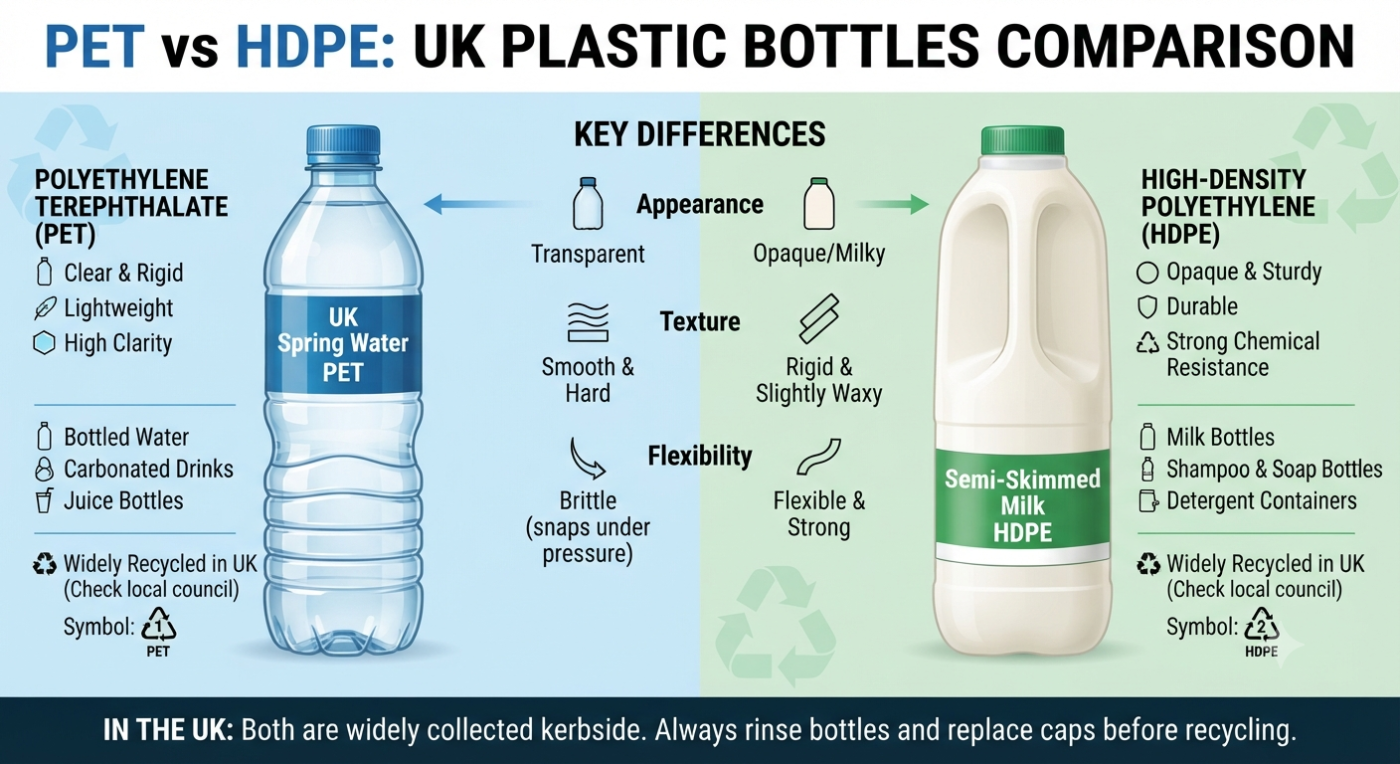
PET is a polymer created by combining ethylene glycol and terephthalic acid. The material is heated and molded into shape, resulting in a glass-like finish that offers unparalleled clarity. This transparency allows your product’s natural colours to shine through, which is vital if you are selling brightly coloured juices, artisanal oils, or luxury hair care solutions.
When you pack these transparent containers into well-designed custom printed boxes uk, the unboxing experience becomes incredibly premium. The crystal-clear surface of PET immediately communicates quality to British consumers who are browsing retail shelves or opening an e-commerce delivery.
Structural Performance and Barrier Protection
PET is incredibly strong despite its lightweight nature. It possesses excellent gas barrier properties, meaning it keeps carbon dioxide inside carbonated beverages while preventing oxygen from creeping in and spoiling your product. This makes it a stellar option for extending the shelf life of food and drink items.
However, PET has a lower heat tolerance compared to other plastics. If your production process involves hot-filling (where liquids are poured into bottles at temperatures exceeding 60°C), standard PET can warp, shrink, or deform. This forces brands to invest in specialized heat-set PET bottles, which drives up production costs significantly.
Understanding HDPE: The Durable, Chemical-Resistant Powerhouse
On the other side of the ring sits High-Density Polyethylene, or HDPE. You recognize this plastic instantly from milk jugs, laundry detergent containers, and industrial chemical jugs. It is translucent or opaque, incredibly tough, and built to survive rough handling.
The Density and Resistance Advantage
HDPE features a high strength-to-density ratio. Its molecular structure is linear with minimal branching, which makes the plastic rigid, highly impact-resistant, and capable of withstanding significant physical stress. If your business ships heavy liquids across the UK, HDPE bottles rarely crack or puncture under pressure.
From a chemical standpoint, HDPE is an absolute tank. It offers exceptional resistance to acids, bases, alcohol, and many solvents. This is why it remains the gold standard for household cleaning products, automotive fluids, and industrial chemicals. It can also handle much higher temperatures than PET, making it a natural fit for hot-fill manufacturing processes without requiring expensive modifications.
The Aesthetic Trade-off
The primary drawback of HDPE is its appearance. It is inherently milky, matte, or opaque. If your product depends on its visual appearance—like a multi-layered bath oil or a vibrant fruit smoothie—HDPE will hide those details from the consumer.
Even when you use vibrant labelling or pair the bottle with high-impact custom retail packaging uk, the container itself will never have that glass-like sparkle that PET effortlessly provides.
Material Properties Matrix
To get a clearer view of how these two plastics stack up against each other for your UK business operations, let’s look at their core technical and physical attributes side by side.
| Property / Feature | PET (Polyethylene Terephthalate) | HDPE (High-Density Polyethylene) |
| Visual Appearance | Crystal clear, high gloss, glass-like | Opaque or translucent, matte finish |
| Impact Resistance | Good, but can crack under extreme crush pressure | Excellent, highly flexible and impact-resistant |
| Chemical Resistance | Moderate; susceptible to strong acids and ketones | Outstanding; highly resistant to chemicals, oils, and acids |
| Temperature Tolerance | Poor for hot-fill (warps above 60°C unless treated) | Excellent (withstands up to 120°C, great for hot-fill) |
| Gas Barrier Efficiency | High (keeps carbonation in, oxygen out) | Moderate (prone to gas permeation over long periods) |
| Recyclability in the UK | Widely recycled (RIC 1), highest collection rates | Widely recycled (RIC 2), highly accepted by councils |
Direct Cost Analysis: Sourcing, Manufacturing, and Logistics
When evaluating PET vs HDPE Plastic Bottles UK, you cannot look at manufacturing in isolation. You have to consider how the physical nature of these bottles impacts your warehousing, transit, and outer packaging requirements, such as custom packaging boxes uk.
Upfront Material and Tooling Costs
Generally speaking, raw PET resin can fluctuate in price depending on global oil markets and regional UK supply chains. However, because PET bottles are usually manufactured using an injection stretch blow molding process, the initial tooling costs for custom shapes can be higher.
HDPE bottles are typically created via extrusion blow molding. This manufacturing method allows for easier creation of integrated handles (like those on milk or detergent jugs) and often keeps tooling costs slightly lower for complex, utilitarian shapes. If your product requires an ergonomic handle or an off-centre neck, HDPE is usually the more cost-effective production route.
Weight, Freight, and Shipping Economics
Both materials are lighter than glass, saving UK businesses thousands of pounds in transport fuel. However, PET bottles can often be engineered with thinner walls while maintaining structural rigidity, making them lighter than an equivalent HDPE container designed for heavy-duty fluids.
When shipping products from fulfillment hubs in the Midlands to retailers across Scotland or Wales, every gram adds up. If your outer transport boxes are poorly optimized, you end up paying to ship trapped air. Pairing lightweight PET or HDPE bottles with precisely engineered custom cardboard boxes uk ensures that your dimensional weight is kept to an absolute minimum, slashing your courier bills.
[ Lightweight Bottle Choice ] + [ Optimized Custom Cardboard Box ] = Minimum Courier Freight Cost
Supply Chain Savings and Outer Packaging Integration
The financial reality of running a product-based business in the UK is that your primary container (the bottle) must work in perfect harmony with your secondary packaging. If your bottles lack structural strength, your outer boxes have to do all the heavy lifting, forcing you to buy more expensive, heavier grades of cardboard.
The Structural Demands on Outer Boxes
Because PET bottles are rigid but have thinner walls, they rely heavily on internal pressure (especially in carbonated drinks) to maintain top-load strength during stacking. If your PET bottles hold non-carbonated liquids like juices or cosmetics, they can collapse under the weight of pallet stacking if they are piled too high.
To prevent this from destroying your stock, you will need to invest in heavy-duty, double-walled cardboard boxes uk from a reliable supplier like CustomBoxes Azz.
On the flip side, HDPE bottles have thick, flexible walls that absorb impacts and bear top-load weight beautifully. This inherent strength means you can often get away with using lighter, more cost-effective custom shipping boxes uk or sleek custom mailer boxes uk without worrying about your bottles warping or leaking during transit.
Secondary Packaging Cost Trade-offs
| Bottle Material | Required Outer Box Strength | Ideal Packaging Type | Cost Impact on Secondary Packaging |
| PET Bottles | Higher crush resistance needed for non-carbonated items | custom corrugated boxes uk | Increases outer packaging costs slightly to prevent crushing |
| HDPE Bottles | Standard crush resistance; bottles support their own weight | custom postal boxes uk | Lowers outer packaging costs; allows lighter board grades |
Branding, Labeling, and Shelf Presence in the UK Market
Your choice in the PET vs HDPE Plastic Bottles UK debate also directly dictates how much money you have to spend on marketing and retail presentation to convince a customer to buy your product.
Maximising the Visual Appeal of PET
If you are selling a luxury product, presentation is your greatest sales tool. PET’s high-gloss, transparent finish allows you to use clear “no-label” looks, making your branding appear printed directly onto the glass. This aesthetic is highly effective for high-end beauty brands and artisan beverage startups operating in competitive markets like London and Manchester.
When these gorgeous bottles are housed in beautifully printed custom branded gift boxes uk or a luxurious custom gift box uk, they create an elite unboxing experience that justifies a higher retail price point, expanding your profit margins significantly.
Overcoming the Utility Look of HDPE
HDPE struggles on the luxury high street because it naturally looks like a utility product. If you put a premium facial oil into an HDPE bottle, consumers might mistake it for a budget item or a household chemical.
To fix this, brands using HDPE must invest heavily in premium tactile labels, silk-screen printing, or intricate external packaging. Many businesses use custom-designed custom boxes packaging uk to completely hide the utilitarian look of the HDPE bottle until the customer opens it at home. By utilizing a high-end customisable gift boxes uk strategy, you can use affordable HDPE bottles for chemical safety while still capturing a premium feel on the shelf.
Environmental Regulations and the UK Plastic Packaging Tax
You cannot talk about plastic packaging in the UK without factoring in government policy, compliance costs, and consumer sentiment. Environmental choices are no longer just about public relations; they have direct financial consequences.
Navigating the Plastic Packaging Tax
The UK Plastic Packaging Tax applies to plastic packaging components manufactured in, or imported into, the UK that contain less than 30% recycled plastic. The tax rate stands at a hefty financial penalty per tonne, making it imperative for businesses to source Recycled PET (rPET) or Recycled HDPE (rHDPE).
- rPET Availability: Recycled PET is highly sought after and widely available due to the massive infrastructure surrounding drink bottle recycling in the UK. However, high demand from multinational beverage conglomerates can sometimes drive up the premium for rPET resins.
- rHDPE Availability: Recycled HDPE is also widely available, often sourced from recycled milk bottles. It is brilliant for non-food applications like detergents and garden chemicals. However, getting food-grade rHDPE can be more challenging and expensive due to strict contamination standards.
If your business fails to hit the 30% recycled content threshold because you chose a scarce or expensive resin grade, the tax penalties will quickly erode whatever money you saved on cheap bottle procurement.
Aligning with Green Consumerism
British shoppers are increasingly scrutinising plastic waste. If your target demographic values sustainability, utilizing easily recyclable PET or clear HDPE bottles can boost your brand loyalty.
To drive the point home, you can showcase your eco-friendly credentials right on your outer shipping containers. Using naturally finished, recyclable custom cardboard packaging uk printed with water-based inks sends a cohesive, powerful green message to your customers, reducing return rates and increasing repeat business.
Industry-Specific Breakdown: Which Material Wins?
Let’s break down the financial winners of the PET vs HDPE Plastic Bottles UK dilemma across different primary market sectors so you can see where your business fits.
1. Food and Beverage Sector
If you are bottling cold-pressed juices, sodas, water, or condiments, PET is almost always the winner. Its gas barrier keeps drinks fresh, and its clarity sells the freshness of the contents.
The only exception is for dairy products or hot-filled sauces. Milk degrades quickly when exposed to light, which is why the opaque, light-blocking qualities of HDPE make it the undisputed, cost-effective king of the dairy aisle. If you run a gourmet takeaway or food delivery startup, pairing your beverages with proper bespoke food packaging uk ensures your entire presentation remains pristine during transport.
2. Cosmetics and Personal Care
For high-end lotions, shampoos, and perfumes, PET wins on style and premium feel. It handles essential oils well and fits perfectly into luxury custom retail packaging uk.
However, for budget personal care items, massive salon-size shampoo jugs, or products containing harsh chemical exfoliants, HDPE takes the crown due to its lower cost at large sizes and its superior chemical durability.
3. Household Chemicals and Industrial Goods
If your business manufactures floor cleaners, window sprays, or engine lubricants, do not even look at PET. HDPE is the mandatory, cost-effective choice. It will not crack when dropped, it resists chemical degradation, and it easily accommodates the heavy handles needed for larger 1-litre to 5-litre volumes.
Because these products are heavy, you should ship them in robust custom delivery boxes uk or reinforced double wall cardboard boxes uk to prevent leaks during courier handling.
Request a Quote
How to Choose Your Perfect Packaging Combination
To stop losing money on your packaging setup, you need to view your bottle and your outer box as a single, unified system. CustomBoxes Azz helps UK businesses design this perfect match every day.
Tailoring the Box to Your Bottle Dimensions
A loose bottle is a vulnerable bottle. If you place your PET or HDPE bottles into standard, off-the-shelf boxes that are too large, the bottles will bounce around during transit. This friction can scuff the beautiful crystal finish of PET bottles or cause the caps of HDPE bottles to crack open.
Investing in custom size boxes uk ensures that your bottles fit snugly inside their outer cartons. This eliminates the need for expensive void-fill materials like bubble wrap or plastic air pillows, saving you money on material costs and reducing your packing time.
[ Snug Bottle Fit ] ---> No Need for Bubble Wrap ---> Lower Packing Costs + Faster Fulfillment
Enhancing the Retail Unboxing Experience
If you are running an e-commerce business, your outer box is your first physical touchpoint with your customer. If you ship your bottles in plain, unbranded boxes, you are missing a massive branding opportunity.
Using custom packaging uk like a branded custom mailer boxes uk or a gorgeous custom printed postal boxes uk turns a simple delivery into an exciting event. If you want to go ultra-premium for a luxury product line, choosing a custom magnetic closure boxes design will make your brand unforgettable, encouraging customers to share their unboxing experiences on social media for free organic marketing.
Summary Checklist: Stop Wasting Money Today
Before you place your next bulk container or box order, run through this quick checklist based on our PET vs HDPE Plastic Bottles UK comparison to ensure your margins are fully protected:
- Check Your Ingredients: Does your product contain heavy essential oils, strong acids, or chemicals? If yes, choose HDPE to avoid chemical degradation and leaks.
- Evaluate Your Filling Process: Are you filling your liquids hot? If your filling line exceeds 60°C, choose HDPE or prepare to pay a premium for specialized heat-set PET.
- Assess the Shelf Appeal: Does your product rely on its vibrant natural colour to attract buyers? If yes, pick PET and pair it with a beautiful custom boxes with logo uk design.
- Calculate Total Shipping Weights: Weigh your bottle prototypes alongside your outer box samples. Use optimized custom postal boxes uk to ensure you aren’t paying extra for wasted dimensional volume.
- Review Your Tax Compliance: Ensure your plastic bottles contain at least 30% recycled material to completely avoid the UK Plastic Packaging Tax penalty.
Partner with CustomBoxes Azz for Your Complete Packaging Strategy
No matter where you land on the PET vs HDPE Plastic Bottles UK spectrum, your bottles cannot travel safely or sell effectively without high-quality secondary packaging. At CustomBoxes Azz, we specialise in crafting bespoke packaging solutions tailored specifically to your product’s physical needs and your business’s financial goals.
From lightweight packaging for small businesses uk to heavy-duty industrial shipping cartons, we ensure your entire packaging ecosystem operates at peak efficiency. Stop guessing, stop overpaying for heavy boxes, and stop risking damaged transit stock. Contact the expert team at CustomBoxes Azz today, and let’s design a high-impact, cost-effective packaging setup that keeps your hard-earned money right where it belongs: in your business.
Deep Dive into Manufacturing: Blow Molding Mechanics and hidden UK Costs
To truly understand how the choice of PET vs HDPE Plastic Bottles UK impacts your business balance sheet, you have to look past the raw material costs and inspect the actual machinery methods used to produce them. The technical differences in manufacturing create a ripple effect that alters your minimum order quantities (MOQs), initial setup fees, and design flexibility.
Injection Stretch Blow Molding (ISBM) for PET
PET bottles are almost exclusively manufactured using Injection Stretch Blow Molding. This is a two-stage process. First, the plastic resin is melted and injected into a high-precision mold to create a “preform”—which looks essentially like a thick glass test tube with the threaded neck already perfectly formed. In the second stage, this preform is reheated, placed inside a bottle-shaped mold, stretched longitudinally with a core rod, and blown with high-pressure compressed air to expand to its final shape.
- The Cost Catch: The high pressures required for injection molding mean that the initial molds must be machined from incredibly durable, high-grade aircraft aluminum or hardened steel. If your UK business wants a completely unique, custom-shaped bottle, the upfront tooling costs can run into thousands of pounds before a single production line even spins up.
- The Scale Benefit: Once the high-cost tooling is completed, the cycle times are incredibly fast. For large-scale production runs, the cost per unit drops drastically. This makes it highly economical for established brands, but an extreme financial barrier for startups testing a new item in the UK marketplace.
Extrusion Blow Molding (EBM) for HDPE
HDPE utilizes a fundamentally different process called Extrusion Blow Molding. Here, the plastic resin is melted down and extruded vertically downwards into a continuous hollow tube called a “parison.” A two-part bottle mold then closes around this molten tube, pinching it off at the bottom and top. Air is injected through a blow pin or needle, inflating the plastic tube to match the inner contours of the cold mold.
- The Cost Catch: Because the parison is pinched at the top and bottom, there is always an element of excess plastic scrap (called “flash”) trimmed away from the bottom seal and the neck ring. While this material is typically ground up and fed back into the extruder, the extra processing steps add subtle labor and energy costs within UK manufacturing facilities.
- The Design Advantage: Because the extrusion process uses much lower internal air pressures than PET blowing, the molds themselves do not need to withstand extreme forces. Consequently, HDPE molds can be manufactured faster and cheaper. Furthermore, EBM easily allows for the creation of capturing geometry, which means you can effortlessly mold an integrated, hollow handle directly onto the body of the container.
Tooling and Sourcing Comparison
| Manufacturing Variable | PET (Injection Stretch Blow) | HDPE (Extrusion Blow) |
| Initial Tooling Cost | High (Requires high-precision steel/alloy molds) | Moderate to Low (Simpler mold designs) |
| Typical UK MOQs | Higher (often 10,000 to 25,000+ units) | Lower (often 5,000 to 10,000 units) |
| Integrated Handles | Extremely difficult / requires multi-piece assembly | Natural and cost-effective to produce |
| Neck Finish Precision | High (pre-molded thread ensures tight cap sealing) | Moderate (requires post-blowing trimming) |
The Freight Volume Trap: How Hollow Air Inflates Transport Overhead
One of the most common ways small and medium-sized UK enterprises lose money when managing PET vs HDPE Plastic Bottles UK decisions is failing to calculate the cost of moving empty space. Unless you own a bottle blowing machine in your own warehouse, you are purchasing empty plastic containers from a manufacturer or distributor and shipping them to your contract filling plant.
The Problem with Pre-Blown Bottles
When you ship 5,000 fully formed 500ml HDPE or PET bottles, you are effectively paying a logistics company to transport a massive truck full of air across the UK motorway network.
Because PET utilizes a two-stage preform system, some larger beverage brands save vast amounts of capital by shipping compact boxes of tiny, unblown preforms to their own filling stations, where a small localized blower inflates them right before filling. However, for most boutique cosmetics or craft soda makers using packaging for small business uk operations, blowing on-site is financially unfeasible due to equipment costs. Therefore, you must buy them fully blown.
[ Truck of Preforms ] = Millions of units per load ---> Ultra low transport cost
[ Truck of Blown Bottles ] = Only thousands of units per load ---> High transport cost per unit
Optimizing Your Palletisation Architecture
If your blown bottles are arriving at your warehouse pre-packed in generic, oversized transit cartons, your freight costs per unit skyrocket. To mitigate this expense, smart operators work directly with custom packaging boxes uk design experts like CustomBoxes Azz to match their pallet dimensions perfectly.
By utilizing engineered custom cardboard boxes uk that are measured down to the millimeter, you can eliminate unnecessary gaps inside the shipping cartons. This allows you to stack more bottles onto a standard UK chemical or Euro pallet, instantly slashing your inward freight costs by up to 20%.
Chemical Compatibility and the Risk of “Panelling”
Choosing the wrong plastic can cause a catastrophic physical phenomenon known as “panelling,” which destroys product presentation and costs your business thousands in returns. Panelling occurs when the atmospheric pressure inside a sealed bottle drops below the ambient air pressure outside, causing the sidewalls of the plastic container to suck inward, warp, and violently distort your branding labels.
What Causes Panelling?
Panelling is generally triggered by three main variables:
- Product Absorption: Certain chemicals, essential oils, or citrus limonene can migrate into the plastic matrix of a bottle wall over time. If you put a high-essential-oil citrus serum into a standard PET container, the liquid can slowly absorb into the polymer, creating an internal vacuum that implodes the bottle structure.
- Oxygen Scavenging: Some chemical formulations, organic juices, or artisanal sauces continue to react with the tiny volume of air trapped in the neck of the bottle after sealing. If they consume that oxygen, the internal volume drops, pulling the walls inward.
- Temperature Drops: If you package a hot liquid (such as a gourmet barbecue sauce or an organic shampoo base) and cap it immediately, the air inside shrinks as it cools down to room temperature.
How PET and HDPE Respond to Pressure
Because HDPE has a more flexible, elastic molecular wall structure, it can sometimes hide micro-vacuums without visually warping, or conversely, it can panel aggressively if the material thickness is too thin. PET, being brittle and rigid, resists minor pressure drops up to a point, but once it crosses its physical threshold, it snaps inward permanently, leaving ugly, permanent crease lines across your custom labeling.
To safeguard your investments, you must run accelerated stability testing on your liquids. If your chemical makeup triggers panelling, you will either need to specify a thicker wall grammage, introduce gas-barrier inner linings, or use heavy-duty custom shipping boxes uk to structurally brace your items during long periods of dark warehouse storage.
Retail Display Strategies and Product Protection
When your goods arrive safely at high-street stores in London, Birmingham, or Edinburgh, the battle moves from survival to conversion. How your bottle interacts with the ambient retail environment can directly affect your product degradation rates and your overall sales figures.
UV Light Degradation Costs
Many premium consumer goods—such as cold-pressed organic oils, boutique craft beers, and active skin serums containing vitamins C or E—are highly sensitive to Ultraviolet (UV) light. Exposure to store lighting can cause oxidation, leading to color changes, rancidity, and flavor spoilage.
- The PET Problem: Standard PET is completely clear, allowing maximum UV light penetration. To protect your formulas, you must purchase tinted amber or cobalt blue PET resins, which carry higher raw material costs. Alternatively, you can house the clear bottle completely inside a light-blocking, premium custom printed boxes uk option.
- The HDPE Advantage: HDPE is naturally opaque or translucent. It diffuses light waves exceptionally well out-of-the-box. An amber or solid white HDPE bottle offers exceptional natural protection against UV damage, protecting your shelf life without requiring expensive chemical UV stabilizers mixed into the plastic blend.
Secondary Luxury Enclosures
If your strategic focus is centered around gift giving or premium retail placement, hiding a utilitarian bottle inside high-end outer casing creates a perceived luxury value.
Brands often opt for more economical, highly chemical-resistant HDPE containers to hold the raw product securely, then dress up the exterior using a beautifully debossed, gold-foiled custom branded gift boxes uk or an elegant custom magnetic closure boxes setup. This hybrid strategy gives you the ultimate chemical peace of mind while securing the premium aesthetic that commands high retail pricing.
[ Affordable Durable HDPE Bottle ] + [ Luxury Custom Magnetic Box ] = High Shelf Value + Lower Risk
Streamlining Warehousing with Modular Box Dimensions
A messy warehouse ruins operational profitability. When you manage a diverse portfolio of liquid products using both PET and HDPE configurations, maintaining an ordered stacking system is critical.
Standardizing Outer Carton Dimensions
If your packaging team is forced to deal with dozens of different irregularly shaped boxes, your picking speeds will slow down dramatically. It pays dividends to create a unified, modular sizing matrix for your transit cartons.
Working with professional packaging consultants allows you to calculate the precise box dimensions uk standards required to hold combinations of 6, 12, or 24 bottles seamlessly. Utilizing a clean, uniform footprint allows your fulfillment staff to assemble custom postal boxes uk rapidly, stack pallets evenly without interlocking errors, and max out the physical height limits of your industrial warehouse shelving units.
Material Stacking Limits
| Container Style | Maximum Safe Pallet Stacking Height | Recommended Box Construction |
| Thin-Wall PET Bottles | 2 Pallets High (Risk of lower-level bottle deformation) | double wall cardboard boxes uk |
| Heavy-Duty HDPE Jugs | 3 Pallets High (High inherent structural support) | single wall cardboard boxes uk |
Consumer Perception and E-Commerce Unboxing Psychology
In the digital-first era of British commerce, the moment your package lands on a customer’s doorstep is a high-stakes marketing event. The tactile feedback of your packaging speaks volumes about your company’s core values.
The “Crinkle” vs The “Solid” Feel
When a consumer squeezes a bottle, their brain immediately registers a quality score based on tactile resistance:
- PET Feedback: Lightweight PET bottles can feel thin or flexible if not pressurized with carbonation. If a consumer opens an expensive e-commerce custom gift box uk and pulls out a bottle that feels flimsy or crinkles loudly when picked up, it devalues the perceived worth of the liquid contents inside.
- HDPE Feedback: HDPE always feels substantial, solid, and soft to the touch due to its matte texture. It conveys a sense of industrial reliability and domestic safety.
Preventing E-Commerce Fulfillment Leakage
E-commerce shipping through networks like Royal Mail, DPD, or Evri is famously harsh. Parcels are thrown onto conveyor belts, dropped from sorting sorting tables, and stacked under heavy weights.
If you are shipping clear PET bottles, any minor structural failure can cause liquid to leak, ruin the beautiful appearance of your inner custom boxes packaging uk, and obliterate the unboxing experience. To guarantee zero-defect arrivals, your outer fulfillment materials must be flawless. Using top-tier custom mailer boxes uk equipped with protective internal corrugated dividers keeps your individual bottles upright, isolated, and completely secure against heavy vibrational impact.
Navigating the Micro-Economics of the Plastic Packaging Tax
As environmental regulations tighten across the UK, tax optimization has become a core business discipline. The UK Plastic Packaging Tax acts as a direct financial levy on any brand failing to innovate with recycled materials. Let’s break down the hidden economic equations that occur behind the scenes.
Sourcing rPET vs Sourcing rHDPE
The financial equation changes when you move away from virgin polymers and transition toward recycled resins:
- The rPET Market Dynamics: Because the UK infrastructure for collecting clear beverage bottles is incredibly efficient, there is a steady stream of high-purity recycled PET flake available. However, because multi-billion-pound global soda giants have committed to using 100% recycled materials, they often buy out entire production capacities years in advance. This fierce competition creates volatile price spikes for small UK businesses trying to source tax-compliant rPET bottles.
- The rHDPE Market Dynamics: Sourcing recycled HDPE is often more locally stable within the UK, as it relies on municipal curbside collections of domestic milk and detergent jugs. While it is beautifully cost-effective for cosmetics and cleaning chemical brands, there is a catch: recycled HDPE often carries a faint grey or off-white color tint and a subtle baseline scent. This means you cannot easily produce a pure, brilliant white bottle using rHDPE, which might force you to adjust your color schemes or use fully enclosing custom retail packaging uk layouts to maintain your visual identity.
[ High rPET Demand from Conglomerates ] ---> Price Volatility for Small Brands
[ Sourcing Local UK rHDPE ] ---> Stable Pricing but Minor Cosmetic Tints
The Ultimate Packaging Design Framework: The 3-Layer Protection System
To maximize your profitability and stop wasting money on broken products or penalizing taxes, your business should implement a highly calculated, multi-tiered approach to your physical assets.
Layer 1: The Primary Container (The Bottle)
Select your bottle material solely based on chemical formulation, required transparency, and filling temperatures. Use our technical guidelines to choose either a high-barrier clear PET for maximum aesthetic impact or a heavy-duty, highly stable HDPE container for long-term product durability. Ensure your supplier guarantees a minimum of 30% recycled content to keep your operation legally insulated from UK tax liabilities.
Layer 2: The Inner Presentation Enclosure
For retail or high-end e-commerce configurations, shield your bottle using bespoke secondary materials. If you chose an economical, opaque HDPE bottle, dress it up beautifully by sliding it into an eye-catching, branded custom boxes uk design or a personalized customisable gift boxes uk option. This structural step completely controls the customer’s first impression, injecting a powerful punch of prestige before they ever see the plastic container inside.
Layer 3: The Outer Transport Architecture
Never trust a standard courier to handle your goods with care. Enclose your retail units within custom-fitted, highly structural custom corrugated boxes uk from CustomBoxes Azz. By tailoring the internal cell dividers and outer walls to match your bottle dimensions perfectly, you create a zero-movement environment that prevents product scuffing, reduces cap fractures, and eliminates structural panelling caused by transit vibration.
Your Financial Roadmap: Partner with CustomBoxes Azz
At the end of the day, selecting between PET and HDPE is only half the battle. The true path to higher margins lies in how effectively you integrate your primary liquids with your outer packaging infrastructure. If your boxes are too large, you are paying to ship air. If your boxes are too weak, your bottles collapse and leak.
At CustomBoxes Azz, we understand the intricate realities of the UK manufacturing, logistics, and retail landscapes. We don’t just sell boxes; we engineer custom packaging ecosystems that protect your products, elevate your branding, and safeguard your bottom line. Contact our expert engineering team today, and let us build the perfect, cost-optimized secondary packaging framework for your business.
Is PET or HDPE more expensive in the UK?
When you are looking at the upfront manufacturing costs, HDPE bottles often come out slightly cheaper for custom shapes because their extrusion molds are less complex to build. However, the true expense depends heavily on your production scale and how you ship your items. Raw PET resin prices can fluctuate wildly with global oil markets, but because it is incredibly lightweight, it can save you massive sums on transport courier fees.
The trick to keeping overall costs low is looking at your entire setup. If you choose thin-walled PET bottles to save on material costs, you will likely need to spend a bit more on sturdier custom corrugated boxes uk to stop them from crushing on the pallet. HDPE bottles hold their own weight beautifully, meaning you can pair them with lighter custom postal boxes uk without risking dangerous leaks during transit across the UK.
Can you use PET bottles for essential oils?
You need to be very careful here because putting pure essential oils or high-concentration citrus formulas into standard PET bottles can cause a total disaster for your stock. Certain highly active organic compounds can slowly migrate into the PET plastic walls, causing the container to break down, lose its structural integrity, or panel aggressively. This means the sides of your bottle will violently suck inward, ruining your beautiful labels and causing product leaks.
If you are running a boutique beauty brand, you are much better off using highly chemical-resistant HDPE bottles, or choosing heavy glass. If you do go with HDPE, remember that it has a milky, matte appearance. To make sure your brand still looks top-tier on the shelf, you can hide that utility look by housing the bottle inside premium custom packaging boxes uk or an elegant custom gift box uk from CustomBoxes Azz.
What is the difference between PET and HDPE plastic bottles?
The easiest way to tell them apart is by looking at their clarity and flexibility. PET is crystal clear and high-gloss, looking almost exactly like real glass. It is fantastic for showing off the vibrant colors of juices or premium cosmetics. HDPE, on the other hand, is naturally translucent or completely opaque with a soft, matte finish.
From a practical standpoint, PET offers an exceptional gas barrier, making it the perfect choice for keeping carbonated drinks fizzy and preventing oxygen from spoiling food items. HDPE is much tougher against impact and highly resistant to aggressive chemicals, which is why it dominates the household cleaning and industrial fluid markets. Whichever option you choose, you need to make sure your containers fit securely inside your transport cartons. Utilizing precisely measured custom size boxes uk ensures that neither material gets scuffed or cracked during courier handling.
Are PET bottles recyclable in the UK?
Yes, PET is the most widely recycled plastic across the entire United Kingdom. Known as Resin Identification Code 1, virtually every local council collects it right from the curb. This makes it a massive favorite for environmentally conscious British shoppers who hate seeing plastic end up in landfill sites.
Because consumers care so much about green issues, you can boost your brand loyalty by matching your easily recyclable bottles with sustainable outer packaging. Shipping your products inside naturally finished custom cardboard boxes uk printed with eco-friendly inks tells a fantastic story. You can easily highlight your green credentials directly on your custom boxes packaging uk layout to show your customers that you care about the planet just as much as they do, keeping them coming back for more.
Which plastic bottle material is best for shipping liquids?
If your main business focus is e-commerce and you are constantly sending items through courier networks like Royal Mail or DPD, HDPE is generally the safer and more cost-effective option. Its flexible, high-density molecular structure handles drops and heavy vibrational impacts incredibly well without cracking open under pressure.
PET can handle the journey too, but its rigid walls are more prone to fracturing if a courier drops a heavy box onto a hard sorting office floor. If you do choose PET for its beautiful visual style, you absolutely must back it up with superior secondary defense. Wrapping your items inside high-quality packaging for small businesses uk like robust cardboard boxes uk with custom internal dividers will isolate each container and completely eliminate the risk of transit damage.
Can HDPE plastic bottles be used for hot fill?
Yes, this is one of the biggest functional advantages that HDPE holds over PET. HDPE can comfortably withstand manufacturing temperatures up to around 120°C, meaning you can pour hot sauces, syrups, or industrial chemical mixtures directly into the bottles right off the production line without worrying about the plastic warping, shrinking, or losing its shape.
Standard PET bottles will instantly deform and melt if you try to fill them with liquids hotter than 60°C. If your product line requires hot filling but you absolutely need the crystal-clear glass look of PET, you will have to pay a massive premium for heat-set PET resins. To offset those high production costs, smart brands save money elsewhere by purchasing high-quality custom printed boxes uk in bulk quantities to keep their overall packaging budgets perfectly balanced.
Is PET plastic stronger than HDPE?
The answer depends entirely on how you define strength. If you are talking about rigidity and tensile strength, PET is the clear winner. It resists stretching and can hold high internal pressures, which is exactly why it is used for sparkling waters and carbonated sodas that would cause a flexible HDPE bottle to puff out and lose its shape.
However, if you define strength as impact resistance and durability against cracking, HDPE takes the crown. If you drop a heavy HDPE jug onto a concrete floor, it will simply bounce and flex absorbing the shock, whereas a rigid PET bottle is far more likely to split open. To ensure your products survive the supply chain regardless of their material strength, you should pack them into heavy-duty custom shipping boxes uk to give them an extra layer of structural armor.
How does the UK Plastic Packaging Tax affect small businesses?
If your business manufactures or imports plastic packaging components into the UK, you face a significant financial penalty per tonne if your containers contain less than 30% recycled plastic. This law was introduced to force brands away from virgin plastics and boost the circular economy.
Sourcing tax-compliant recycled PET (rPET) or recycled HDPE (rHDPE) can be tricky and expensive due to high demand, but failing to do so will directly eat into your profit margins. To stay compliant and keep your brand image pristine, many companies combine recycled bottles with proudly plastic-free secondary materials. Housing your eco-friendly bottles in beautifully branded custom boxes uk or high-end custom branded gift boxes uk tells a highly cohesive green story that modern British consumers will happily pay a premium for.
Do clear plastic bottles degrade in sunlight?
Yes, clear plastic containers offer virtually zero protection against Ultraviolet (UV) light waves. If you store clear PET bottles near warehouse windows or place them under bright supermarket retail lights, the UV rays will pass right through the plastic and attack your liquids. This can cause color fading, ingredient separation, and rancid smells in active cosmetics or organic food products.
HDPE is naturally opaque and does a much better job of diffusing light, but it still isn’t completely immune. If you want to use beautiful clear PET bottles without risking product spoilage, you should keep them fully protected during storage and transport. Enclosing your retail stock inside dark, light-blocking custom mailer boxes uk or structurally sound custom postal boxes uk ensures your formulas stay perfectly safe until the customer opens them.
How do I choose the right outer packaging for shipping plastic bottles?
To pick the perfect outer carton, you must analyze the weight, dimensions, and shape of your bottles as a complete system. If you are shipping heavy HDPE chemical jugs, your boxes need high puncture resistance, while thin PET cosmetic bottles require excellent top-load crush defense to survive being stacked high on warehouse pallets.
You should always avoid generic, stock-sized boxes. When bottles have too much room to slide around inside a carton, the friction will scuff up the glossy surface of PET or crack the caps of your HDPE containers. Partnering with CustomBoxes Azz to create tailored custom packaging uk with custom-cut internal dividers keeps your items locked in place. This smart move eliminates the need for plastic bubble wrap, speeds up your packing lines, and creates an unforgettable, professional presentation.
