
Industry Insights
What Is the Standard Business Card Size in the UK? – Business Card Size UK
May
Business cards might look small, but they still play a big role in networking, branding, and first impressions. Whether you own a café in Manchester, a salon in Birmingham, or an online shop using business card size UK packaging materials, understanding the right business card dimensions UK can help you create professional printed materials. Many people assume all business cards are the same size worldwide, but that’s not actually true. Different countries use different dimensions, so knowing the standard business card size and UK business card size can make your design and printing process much easier. In this guide, we’ll explain the business cards size UK, size of business card, business card size inches, average business card size, business card standard size, and business card size mm, along with practical printing tips, paper choices, and how your business card can work alongside your packaging and wider branding.
Standard Business Card Size in the UK
The standard business card size in the UK is:
| Measurement Unit | Standard UK Business Card Size |
|---|---|
| Millimetres | 85 mm × 55 mm |
| Centimetres | 8.5 cm × 5.5 cm |
| Inches | 3.35 in × 2.17 in |
| Pixels (300 DPI) | 1004 × 650 px |
This size is widely accepted across the UK because it fits easily into wallets, cardholders, and pockets.
Most professional printers, including companies offering custom packaging boxes UK, design print templates around this standard dimension.
Why the Standard Size Matters
You may wonder why card size matters at all. After all, isn’t the design more important?
The truth is that size affects usability and professionalism.
A business card that is too large can feel awkward to store. A card that is too small may look cheap or get lost easily. Standard dimensions exist because they create balance between practicality and branding.
Here’s why UK businesses stick with the standard size:
- Fits neatly into wallets and holders
- Easier and cheaper to print
- Compatible with most printing templates
- Looks professional and familiar
- Works well for networking events and trade shows
Brands that already invest in quality packaging such as bespoke packaging UK often keep the same professional consistency in their printed marketing materials too.
UK Business Card Size vs Other Countries
Business card dimensions vary across regions. If you work with international clients, understanding these differences can help when designing cards for global use.
| Country | Standard Size |
|---|---|
| UK | 85 × 55 mm |
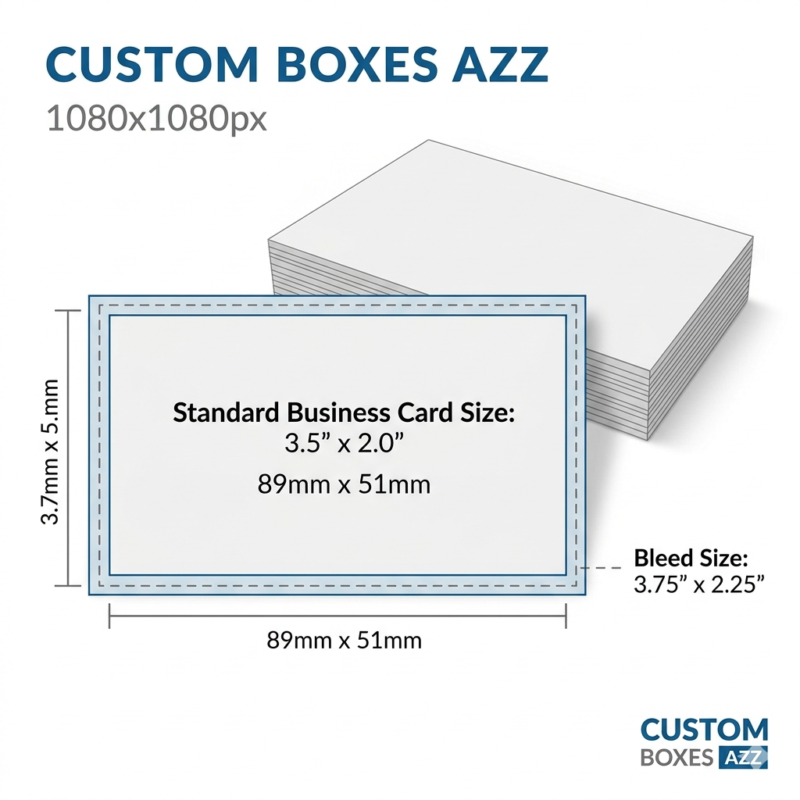
| USA & Canada | 89 × 51 mm |
| Europe | 85 × 55 mm |
| Japan | 91 × 55 mm |
| Australia | 90 × 55 mm |
The UK standard is also commonly used across Europe, which makes it practical for businesses trading internationally.
Bleed Area and Safe Margins Explained
When creating a business card design, the final size is not the only thing you need to consider.
Professional printing also includes:
| Design Area | Recommended Size |
|---|---|
| Final Card Size | 85 × 55 mm |
| Bleed Area | 91 × 61 mm |
| Safe Margin | Keep text 3–5 mm inside |
What Is Bleed?
Bleed is extra space added around the edges of the design to avoid white borders after trimming.
What Is the Safe Margin?
The safe margin keeps important elements like text and logos away from the edge so they don’t get cut off.
These details matter whether you are printing business cards, product labels, or luxury gift boxes UK.
Common Business Card Orientations
Business cards are not limited to one format. You can choose different orientations depending on your branding.
Horizontal Business Cards
This is the most common format in the UK.
Best for:
- Corporate businesses
- Consultants
- Retail brands
- Service providers
Vertical Business Cards
These are modern and eye-catching.
Best for:
- Designers
- Artists
- Fashion brands
- Luxury brands
Square Business Cards
Square cards stand out but may not fit standard wallets easily.
Best for:
- Creative industries
- Boutique brands
- Premium packaging companies
Businesses using custom boxes London often pair modern business card styles with premium packaging aesthetics for stronger branding.
Popular Business Card Paper Types
Paper quality changes how your card feels in someone’s hand. A flimsy card can make your business seem less trustworthy, while premium stock creates a stronger impression.
| Paper Type | Appearance | Best For |
|---|---|---|
| Matte | Smooth, non-shiny | Professional brands |
| Glossy | Reflective finish | Bold colourful designs |
| Uncoated | Natural texture | Minimalist brands |
| Soft Touch | Velvet feel | Luxury businesses |
| Recycled Paper | Eco-friendly look | Sustainable brands |
Many businesses that use custom gift packaging UK also choose thicker or textured business cards to match their premium identity.
Recommended Business Card Thickness
Thickness is measured in GSM (grams per square metre).
| Thickness | Feel | Common Usage |
|---|---|---|
| 250 GSM | Lightweight | Budget cards |
| 350 GSM | Standard premium | Most UK businesses |
| 450 GSM | Thick luxury feel | Premium branding |
| 600 GSM+ | Ultra-thick | High-end luxury brands |
If your company already invests in protective packaging UK, premium business cards can reinforce your commitment to quality.
What Information Should Be on a Business Card?
A business card should be clean, simple, and easy to read.
You do not need to overcrowd it.
Essential Information
Include:
- Business name
- Your name
- Job title
- Phone number
- Email address
- Website
- Social media (optional)
- QR code (optional)
Optional Extras
Some brands also add:
- Brand slogan
- Appointment booking links
- Product categories
- Packaging specialities
For example, a company specialising in custom packaging for small business UK may highlight services like eco-friendly boxes or custom printing.
Choosing the Right Design Style
Your card design should reflect your brand identity.
Minimalist Design
Best for:
- Consultants
- Accountants
- Law firms
Features:
- Simple typography
- White space
- Neutral colours
Luxury Design
Best for:
- Cosmetics
- Jewellery
- Gift packaging brands
Features:
- Foil stamping
- Embossing
- Thick cardstock
Creative Design
Best for:
- Artists
- Agencies
- Designers
Features:
- Bold colours
- Unusual layouts
- Custom shapes
If your packaging already has a distinctive look, your business card should visually match it. This creates consistency across your branding materials.
Rounded Corner vs Square Corner Cards
One small detail can completely change the feel of a business card.
| Style | Appearance | Advantages |
|---|---|---|
| Square Corners | Traditional | Professional and classic |
| Rounded Corners | Modern | Softer and more stylish |
Rounded corners are especially popular with premium retail and packaging businesses.
Best Printing Finishes for Business Cards
Finishes can make your business card feel more memorable.
Matte Lamination
- Smooth finish
- Easy to read
- Elegant look
Gloss Lamination
- Bright colours
- Reflective appearance
- Eye-catching
Spot UV
Adds shine to selected areas like logos.
Foil Stamping
Adds metallic effects using gold, silver, or coloured foil.
Embossing
Raises certain design elements for texture.
Luxury brands using bespoke packaging UK often use foil and embossing to create a premium feel.
Why Business Cards Still Matter in the Digital Age
Some people think business cards are outdated because of social media and smartphones.
That’s not really the case.
Business cards still offer something digital platforms cannot: a physical first impression.
At networking events, trade shows, and business meetings, handing someone a well-designed card feels more personal and professional than asking them to search your Instagram page.
A good business card also:
- Builds trust
- Increases brand recall
- Makes your business easier to contact
- Supports local marketing
- Strengthens offline networking
How Packaging and Business Cards Work Together
Your packaging and printed materials should feel connected.
Imagine receiving luxury skincare products in elegant packaging but finding a low-quality business card inside. The experience immediately feels inconsistent.
That’s why many brands align:
- Packaging colours
- Typography
- Logo placement
- Printing finishes
- Material quality
Businesses offering custom packaging boxes UK often use matching branding across:
- Shipping boxes
- Gift packaging
- Product inserts
- Thank-you cards
- Business cards
This creates a stronger customer experience.
Eco-Friendly Business Cards in the UK
Sustainability matters more than ever for UK consumers.
Many businesses now choose:
- Recycled paper
- Soy-based inks
- Plastic-free finishes
- Kraft card materials
Eco-friendly cards work especially well for brands already using sustainable packaging.
If your business focuses on environmentally friendly packaging, your business card should support the same message.
You can also explore packaging ideas from guides like small business food packaging ideas in UK for inspiration on cohesive sustainable branding.
Request a Quote
Business Card Design Mistakes to Avoid
Even expensive cards can fail if the design is poor.
Using Too Much Text
Keep information concise.
Tiny Fonts
Readable typography matters.
Low-Quality Images
Blurry logos instantly reduce professionalism.
Poor Colour Contrast
Text should always be easy to read.
Ignoring Bleed Margins
Improper setup can ruin the final print.
Cheap Paper Stock
Thin cards often feel disposable.
Digital Business Cards vs Printed Business Cards
Digital cards are becoming more common, but printed cards still dominate face-to-face networking.
| Feature | Printed Cards | Digital Cards |
|---|---|---|
| Physical Presence | Yes | No |
| Easy Sharing | Moderate | Instant |
| Memorability | High | Moderate |
| Cost | Printing required | Usually subscription-based |
| Luxury Feel | Excellent | Limited |
Many businesses use both together.
For example:
- Printed card with QR code
- NFC-enabled cards
- Cards linking to online portfolios
Custom-Shaped Business Cards
Some businesses move beyond standard rectangles.
Popular shapes include:
- Rounded square
- Circle cards
- Folded mini cards
- Die-cut shapes
Custom shapes work best when aligned with your industry.
If you are interested in custom cutting styles, you may also enjoy this guide on what is die cutting.
How Luxury Brands Use Business Cards
Premium brands treat business cards as part of the customer experience.
Luxury businesses often use:
- Thick layered cards
- Metallic foils
- Velvet finishes
- Edge painting
- Minimal designs
The same approach is often used in luxury gift boxes UK, where presentation influences customer perception.
A luxury business card should feel impressive before the person even reads it.
Matching Business Cards With Product Packaging
Strong branding comes from consistency.
You can align:
- Colour palettes
- Packaging materials
- Print finishes
- Logo styles
- Typography
For example:
- Kraft packaging pairs well with recycled business cards
- Gloss packaging works with glossy cards
- Minimalist boxes pair with clean card layouts
Brands using custom packaging boxes London often build unified visual identities this way.
Should You Use QR Codes on Business Cards?
QR codes have become increasingly popular in the UK.
They can link directly to:
- Websites
- Social media
- Booking systems
- Product catalogues
- Contact information
Benefits include:
- Faster contact saving
- Improved engagement
- Better tracking opportunities
Just make sure the QR code does not dominate the design.
Best Colour Choices for Business Cards
Colour psychology matters in branding.
| Colour | Common Brand Message |
|---|---|
| Black | Luxury and sophistication |
| Blue | Trust and professionalism |
| Green | Sustainability and health |
| Red | Energy and confidence |
| White | Minimalism and simplicity |
If your packaging already uses strong brand colours, your business card should stay visually connected.
Packaging Inspiration for Small Businesses
Business cards are only one part of your branding strategy.
Small businesses can strengthen customer experience by combining:
- Professional business cards
- Product inserts
- Thank-you notes
- Branded packaging
- Packaging bags
You can explore packaging options like custom packaging bags UK to create a more memorable presentation.
For local businesses in areas like Coventry or Glasgow, customised packaging also helps improve regional brand recognition through services like:
Business Card Trends in the UK
Business card trends continue to evolve.
Popular modern trends include:
- Minimalist layouts
- Soft-touch finishes
- Sustainable materials
- QR integration
- Vertical layouts
- Monochrome designs
- Thick luxury cards
Creative industries often push trends further with:
- Transparent cards
- Metallic papers
- Textured stocks
- Die-cut edges
Why Professional Printing Makes a Difference
DIY business cards rarely match professional printing quality.
Professional printers offer:
- Accurate colours
- Sharper text
- Better trimming
- Premium finishes
- Stronger cardstock
This matters even more when your business focuses heavily on presentation and packaging quality.
A professionally printed business card reinforces your credibility immediately.
Final Thoughts on UK Business Card Sizes
The standard business card size in the UK is 85 × 55 mm, and there’s a good reason this format remains popular. It is practical, professional, and widely accepted across industries.
Still, size alone does not make a business card effective.
Your card should reflect your brand identity through:
- Material quality
- Printing finish
- Typography
- Colour choices
- Consistent branding
When paired with strong packaging and presentation, a well-designed business card becomes more than a contact tool. It becomes part of the overall customer experience.
Brands using custom boxes UK and premium packaging solutions often see better brand recognition because every printed element feels connected and intentional.
Whether you choose a simple matte card or a luxury foil-stamped design, the key is making sure your business card leaves a lasting impression.
Business cards may be small, but they have a big role in networking, branding, and creating a strong first impression. Whether you run a café, salon, agency, retail shop, construction company, or online business, choosing the right Business Card Size UK can make your printed materials look more professional. The correct business card dimensions UK businesses commonly use can also make designing, printing, storing, and carrying your cards much easier.
Many people search for the standard business card size because they want a reliable starting point before creating artwork. Others search for business cards size UK, size of business card, or UK business card size because they are unsure whether British cards use the same measurements as American or European cards.
The good news is that understanding Business Card Size UK requirements does not have to be complicated. Once you know the usual dimensions, you can choose your preferred paper, prepare your artwork correctly, and decide whether a traditional or custom format is better for your brand.
What Is the Standard Business Card Size UK?
The commonly used Business Card Size UK is approximately 85 mm × 55 mm. This is widely recognised as the typical format for professional business cards in Britain.
When people ask about business card dimensions UK, they are usually referring to this familiar rectangular format. It is compact enough to fit easily inside a wallet or card holder while still providing enough room for a logo, name, contact details, website, and social media information.
The standard business card dimensions can be written in several ways depending on how the information is being searched or prepared for printing:
- 85 × 55 mm
- 8.5 × 5.5 cm
- Approximately 3.35 × 2.17 inches
For most businesses, this business card standard size is a practical option because it is familiar, easy to handle, and suitable for professional printing.
Business Cards Size UK in Millimetres and Centimetres
If you are preparing artwork, understanding the business card size mm measurement is particularly useful because professional print files are often created using millimetres.
The usual business card sizes UK measurement is around 85 mm × 55 mm. In centimetres, this is approximately 8.5 cm × 5.5 cm.
| Measurement | Common UK business card format |
|---|---|
| Millimetres | 85 × 55 mm |
| Centimetres | 8.5 × 5.5 cm |
| Inches | Approximately 3.35 × 2.17 in |
| Orientation | Landscape or portrait |
When someone searches for uk business card sizes, business card UK size, or uk business card dimensions, they are often looking for this same commonly used format.
The phrase size of visiting cards is another way people describe business card measurements, particularly in regions where “visiting card” is more commonly used. Similarly, size of name card can refer to essentially the same type of printed networking card.
What Is the Typical Business Card Size?
The typical business card size in the UK is around 85 × 55 mm, making it a convenient format for everyday business use.
The common business card size is popular because it provides a good balance between useful information and portability. You can normally include:
- Company logo
- Your name
- Job title
- Telephone number
- Email address
- Website
- Social media information
- Business address
- QR code
The business cards size standard should not prevent you from being creative with your design. You can use typography, colour, spacing, and finishing to make the card distinctive while keeping the physical dimensions familiar.
For businesses wanting standard size business cards, the traditional UK format remains a sensible choice.
Business Card Size Inches
Some design software and international printing platforms use inches rather than millimetres. Therefore, understanding business card size inches can be helpful when preparing artwork.
The approximate UK format is 3.35 × 2.17 inches.
If you are searching for business card size in, business card sizes inches, or size business card inches, remember that the exact conversion from millimetres can produce a decimal measurement rather than a perfectly rounded inch size.
For this reason, professional UK printers will often prefer the artwork to be supplied using millimetres.
British Business Card Size Compared With Other Countries
The British business card size is not necessarily identical to every international format. Businesses working with overseas customers may encounter different dimensions.
For example, an American size business card is commonly around 3.5 × 2 inches, while European formats can differ from the familiar UK format.
| Region | Approximate common format |
|---|---|
| UK | 85 × 55 mm |
| USA | 89 × 51 mm |
| Europe | Often around 85 × 55 mm |
| Custom | Can vary according to requirements |
This is why businesses working internationally should check the required format before sending artwork to print.
Searches such as european business card size, european size business cards, business card size EU, euro business card size, and european business cards size generally refer to European formats that may be similar to, but are not necessarily identical to, every UK specification.
Likewise, business card US size may be different from the standard British format.
Standard Business Card Design and Dimensions
The physical size is only one part of creating a professional card. Your standard business card design should use the available space carefully.
A good design should have enough breathing room around important information. Trying to fit too much text onto a small card can make it difficult to read.
Before sending your artwork to print, check your:
- Logo size
- Font size
- Contact information
- Website address
- QR code
- Colour contrast
- Bleed
- Safe area
- Final dimensions
Your business card standard dimensions should be confirmed before exporting the final artwork. If you are using a standard format, keeping your important information away from the cutting edge is particularly important.
Business Card Printing Size and Print Preparation
Your business card printing size should match the final trimmed dimensions while allowing sufficient bleed around the artwork.
For example, if your finished card is 85 × 55 mm, the artwork file may need to be slightly larger depending on the printer’s bleed requirements.
This is why business card print size, print business card size, and business card size specs are useful terms to understand when preparing a professional print file.
The dimensions for business card artwork should be checked before production, while dimensions for business cards can also refer to the physical finished card.
Your business card image size matters too if you are using photographs, logos, or raster graphics. Images should have sufficient resolution so they do not appear blurry when printed.
Business Card Paper Size and Material
The business card size paper you select can influence the overall feel of your card. Although the dimensions of the finished card are important, paper thickness and finish can make an equally noticeable difference.
The business card paper size should be suitable for the final trimmed format, while your chosen paper stock should match your brand.
Common options include:
- Standard smooth card
- Matte card
- Gloss finish
- Textured card
- Premium heavyweight stock
- Recycled paper
- Laminated card
The business card paper size itself is only one consideration. You should also think about whether you want a soft-touch feel, writable surface, gloss appearance, or a more natural paper texture.
Custom Business Card Sizes
Although the traditional Business Card Size UK is suitable for most businesses, custom formats can make your card stand out.
A custom business card size might be narrower, taller, square, folded, or designed around a particular brand concept.
Businesses interested in custom business card sizes should remember that unusual dimensions can affect:
- Printing costs
- Cutting
- Storage
- Card holders
- Envelopes
- Mailing
- Customer convenience
A small business card size may look distinctive, but it can provide less space for contact details. A narrow business card size can work well for minimalist designs but should still remain readable.
For most brands, a regular business card size remains the easiest option, especially when the card needs to fit standard wallets and holders.
Business Card Size for Digital Design
If you are designing your card digitally, you may also need to understand pixels.
The pixel size business card depends on the physical dimensions and the resolution being used. A print file prepared at a higher resolution will contain more pixels than one prepared at a lower resolution.
Terms such as business card pixel size, business card size px, business cards size pixels, business card in px, and business card px size are therefore usually connected to digital artwork rather than the physical printed card.
Your business card file size can also vary depending on whether the design is supplied as PDF, AI, EPS, PNG, or another file format.
Similarly, business card page size may refer to the document or artboard used to create the design rather than the final physical card.
For professional printing, always check the printer’s artwork requirements before exporting the final file.
Understanding Business Card Measurements
If you are comparing measurements for business cards, the most important thing is to distinguish between the final trimmed card and the artwork document.
The dimension of business card usually refers to the finished product, while dimension for business card may refer to the design setup.
You may also come across searches for size for business cards, size of business cards, size for business card, and sizes of business cards. These phrases all point toward the same basic question: what physical dimensions should the finished card have?
For a traditional UK design, the answer is generally around 85 × 55 mm.
Business Card Size in CM
If you prefer working in centimetres, the standard UK format is approximately 8.5 × 5.5 cm.
This makes the business card cm size easy to understand when planning physical layouts.
Searches such as size business card cm usually refer to the same conversion. If your designer or printer requests centimetres rather than millimetres, simply make sure the units are clearly specified before production.
What Is the Normal Business Card Size?
The normal business card size in the UK is approximately 85 × 55 mm. This can also be described as the business card usual size, standard business card sizes, or standard business card dimension.
There are several related ways people search for the same information, including:
- business card standard sizes
- standard business card dimension
- business card standard sizes
- business card dimensions standard
- standard business card sizes
- standard business card size
- business card standard size
- standard size business card
While these phrases vary, they are generally asking about the accepted dimensions used for professional cards.
Business Card Size Specs to Check Before Printing
Before you order, confirm the business card size specs with your printer. This is especially important if you are using a custom format.
Your final checklist should include:
- Finished card dimensions
- Bleed requirements
- Safe area
- File format
- Image resolution
- Colour mode
- Paper stock
- Finish
- Quantity
- Single or double-sided printing
Understanding the official business card size is useful, but there is not necessarily one universal mandatory dimension for every UK business card. The commonly used 85 × 55 mm format is a practical industry standard rather than a rule that every company must follow.
Choosing the Right Size for Your Brand
For most companies, sticking with the traditional Business Card Size UK is a sensible decision. It is familiar, easy to carry, and provides enough room for essential information.
If you want something more distinctive, a custom business card size can create a stronger visual identity. However, the unusual format should still be practical for your customers.
Before choosing the final size, consider where the card will be used. If you regularly attend networking events, a conventional format is easy to store. If your card is mainly included inside product packaging, you may have more freedom to experiment.
This is particularly useful for businesses that use branded packaging because the card can be designed to fit neatly inside the box without wasting internal space.
Understanding Business Card Dimensions UK
When preparing artwork for printing, it is useful to understand the difference between the finished card and the design file. The commonly used Business Card Size UK is around 85 × 55 mm, but your artwork may need additional space for bleed and safe margins.
This is why searches such as business card dimensions standard, business cards standard dimensions, standard size business cards, and business card standard sizes can be useful when preparing your design.
There is not one legally required official business card size that every company must use. Instead, the familiar UK format is widely used because it is convenient, professional, and easy to store.
If you are comparing standard business card dimensions, remember that the finished card size and artwork size are not necessarily identical. Your printer may require extra bleed around the edges so that trimming does not leave unwanted white lines.
Business Card Size UK in Different Units
The standard Business Card Size UK is generally around 85 × 55 mm. Depending on the software or printing service you are using, you may need to work in millimetres, centimetres, or inches.
| Unit | Approximate UK size |
|---|---|
| Millimetres | 85 × 55 mm |
| Centimetres | 8.5 × 5.5 cm |
| Inches | 3.35 × 2.17 in |
The business card mm size is especially useful for print preparation because professional printers commonly use millimetres.
If you are working in centimetres, the business card cm size is approximately 8.5 × 5.5 cm. Searches for business card sizes cm and size business card cm generally refer to this same measurement.
For designers working in inches, business card size inches, business cards size inches, business card sizes inches, and size business card inches can all be useful search variations.
Business Card Size MM and Printing
When preparing your final artwork, always check the business card size mm before exporting the file. Even a small mistake in the dimensions can affect the final printed result.
Your business card printing size should be based on the finished dimensions, while the artwork file may need additional bleed.
The terms business card print size, print business card size, and business card size specs are often used when discussing the technical requirements for printing.
For example, if your finished Business Card Size UK is 85 × 55 mm, your printer may request artwork that extends beyond those dimensions to allow for trimming.
This is why checking the printer’s specifications before designing is always worthwhile.
Business Card Paper Size and Printing Quality
The business card paper size should match the final card dimensions, but the paper itself can have a major impact on how the finished card feels.
A simple card can look completely different depending on its stock and finish.
You might choose:
- Smooth uncoated card
- Matte laminated card
- Gloss laminated card
- Textured stock
- Recycled paper
- Premium heavyweight card
When considering business card paper size, think about where the cards will be used. A networking card might benefit from a durable finish, while a creative business could prefer a textured or unusual stock.
The business card paper size also needs to be compatible with your chosen printer and finishing method.
American, European and UK Business Card Sizes
If you work with international clients, you may come across different dimensions.
The American size business card is commonly around 89 × 51 mm, which is slightly wider and shorter than the familiar UK format.
European cards can vary as well, which is why searches such as european business card size, european size business cards, business card size eu, euro business card size, european business cards size, and europe business card size can produce different results depending on the country.
For businesses operating in Britain, the British business card size of approximately 85 × 55 mm remains a practical choice.
You may also see searches for uk business card sizes, uk business card dimensions, uk business card size, uk business cards size, and business cards uk size. These generally relate to the commonly used UK format.
Business Card Size Standard and Common Formats
The business card size standard is useful because it gives designers and businesses a familiar starting point.
The common business card size is compact enough to carry comfortably while providing enough room for essential information.
You may encounter terms such as typical business card size, business card normal size, normal business card size, regular business card size, traditional business card size, and average size business card.
Although these phrases sound slightly different, they are generally describing the familiar professional business card format.
The average business card size is not a strict legal measurement. Businesses can choose custom dimensions if they want something different.
Custom Business Card Sizes for Unique Branding
A standard format is not always the best option for every brand. If your business has a creative identity, you may want to experiment with custom business card sizes.
A custom business card size could be:
- Square
- Narrow
- Tall
- Miniature
- Folded
- Die-cut
- Unusually shaped
A small business card size can work for minimalist branding, but you should make sure there is enough room for your contact details.
A narrow business card size can look stylish and modern, although it may be less convenient for traditional wallets and card holders.
When choosing size for business cards, think about both appearance and practical use.
The size for business card should provide enough space for the information your customers actually need.
Size of Visiting Card and Name Card
Some people use the term “visiting card” instead of business card. If you are searching for the size of visiting cards, size of visiting card, or size for visiting card, you are generally looking for the dimensions of a professional contact card.
Likewise, size of name card and size for name card can refer to the same general type of printed card.
The familiar UK format remains approximately 85 × 55 mm, but there is no requirement that every visiting card or name card must use this exact dimension.
Dimensions for Business Cards
Before printing, check the dimensions for business cards carefully. Your finished card should have clearly defined dimensions, while your artwork should include the correct bleed and safe area.
The dimensions of business cards can vary depending on whether you choose a standard or custom format.
For a conventional UK design, you can use approximately:
85 mm × 55 mm
This is also commonly described as the business card standard dimensions or standard business card dimension.
When preparing a file, your designer may use a larger document size to accommodate bleed. Therefore, the business card page size in your design software may be slightly larger than the finished card.
Business Card File Size and Image Resolution
The physical dimensions are not the only technical details that matter.
Your business card file size can depend on the file format, image quality, number of design elements, and resolution.
If your design contains photographs or detailed graphics, check the business card image size and image resolution before printing.
You may also encounter searches for pixel size business card, business card pixel size, business card size px, business cards size pixels, business card in px, and business card px size.
These terms relate to digital artwork rather than the physical dimensions of the printed card.
For example, a designer may create a high-resolution digital file that contains many more pixels than the physical card measurement would suggest. That is normal because print artwork needs sufficient resolution for sharp output.
Business Card Size in Pixels
There is no single universal business card size in pixels because pixel dimensions depend on the resolution used.
For print work, the physical measurement in millimetres is more important than the pixel dimensions.
If a printing company provides a specific template, follow its instructions rather than converting the Business Card Size UK yourself.
This is especially important for terms such as business card image size, business card pixel size, business card size px, and business cards size pixels, because different design resolutions produce different pixel measurements.
Business Card Design and Safe Areas
A professional standard business card design should be easy to read and visually balanced.
Even when using the standard size business cards format, you have plenty of ways to make the design unique.
You can use:
- A bold logo
- Minimal typography
- Brand colours
- Premium finishing
- QR codes
- Simple icons
- Strong contrast
- Carefully spaced contact details
Your business card dimensions standard should remain consistent while the visual design can change according to your brand.
A good business card standard design should avoid placing important information too close to the cutting edge.
Business Card Size Specs for Professional Printing
Before sending your artwork to production, create a simple checklist.
| Specification | What to check |
|---|---|
| Finished size | Around 85 × 55 mm for a common UK format |
| Bleed | Follow printer’s requirements |
| Safe area | Keep important content away from edges |
| Resolution | Use suitable print-quality artwork |
| Colour | Follow the printer’s colour requirements |
| File format | Confirm PDF, AI, EPS or required format |
| Paper | Select suitable card stock |
| Finish | Matte, gloss, textured, etc. |
These details are particularly important if you are ordering a large quantity.
Choosing Between Standard and Custom Sizes
For most businesses, the familiar Business Card Size UK is a reliable option. It is easy to carry, recognisable, and suitable for professional networking.
A custom format can make your brand more memorable, but it should still be practical.
For example, if your customers regularly put your card into a wallet, a conventional format may be preferable. If the card is primarily included inside a product package, you may have more freedom to use a distinctive shape or dimension.
The best size standard business card choice depends on how you expect people to use it.
Business Card Envelope Size
If your cards are being mailed or presented inside envelopes, you should consider the business card envelope size as part of the overall design.
The envelope needs to provide enough room for the card without making it unnecessarily loose.
For promotional mailings, event invitations, corporate gifts, and packaging inserts, the relationship between card size and envelope size can be important.
Credit Card Dimensions UK vs Business Cards
People sometimes compare credit card dimensions UK with business cards because both are small rectangular items designed to fit comfortably into wallets.
However, they are not necessarily the same dimensions.
A credit card follows its own standard format, while Business Card Size UK is commonly around 85 × 55 mm.
This slight difference can matter if you are designing a wallet-sized product, card holder, insert, or packaging compartment.
Choosing the Right Business Card Size for Your Brand
The right size ultimately depends on how you want your card to function.
If you want something familiar and practical, choose the common UK format. If you want something more creative, explore custom business card sizes while making sure your information remains easy to read.
For most businesses, the traditional format provides enough space for:
- Logo
- Name
- Position
- Phone number
- Website
- Social media
- QR code
A carefully planned Business Card Size UK can therefore support your brand without making the design feel crowded.
Final Business Card Size Checklist
Before sending your design to print, confirm:
- Business Card Size UK: approximately 85 × 55 mm
- Business card dimensions UK: check final trimmed dimensions
- Standard business card size: confirm with your printer
- Business card size mm: use millimetres for accurate print preparation
- Business card size inches: approximately 3.35 × 2.17 inches
- Business card size paper: select suitable card stock
- Business card printing size: include correct bleed
- Business card image size: use high-resolution images
- Business card file size: follow the printer’s file requirements
- Business card envelope size: make sure the card fits comfortably
The standard format is a strong starting point, but your brand does not have to look ordinary. With the right dimensions, paper, artwork, and finishing, even a simple business card can create a professional impression.
For businesses that need a familiar, practical, and easy-to-print format, Business Card Size UK at approximately 85 × 55 mm remains an excellent choice.
What is the standard business card size in the UK?
The standard business card size in the UK is 85 mm × 55 mm. This size is commonly used because it fits neatly into wallets, cardholders, and pockets without bending or looking oversized. Most UK printing companies design templates around these dimensions, making it easier and more affordable to print professional cards.
If you run a business and already use branded packaging such as custom boxes UK, keeping your business card within standard dimensions helps maintain a polished and professional image. Standard sizing also works well for networking events, trade shows, retail counters, and packaging inserts. While some brands experiment with square or die-cut cards, the classic UK size remains the safest and most practical option for everyday business use.
Why do businesses still use printed business cards?
Printed business cards are still valuable because they create a personal and professional first impression. When you hand someone a physical card, it feels more memorable than quickly sharing a phone number or social media handle. People are more likely to remember your brand when they can physically hold something connected to your business.
Business cards also work well alongside branded packaging and marketing materials. For example, companies using custom packaging boxes UK often include business cards inside orders to encourage repeat customers and improve brand recognition. A well-designed card can help customers contact you later, visit your website, or follow your business online. Even in a digital world, physical branding still has strong impact during meetings, exhibitions, and local networking opportunities.
What paper thickness is best for business cards?
Most businesses in the UK choose business cards between 350 GSM and 450 GSM because they feel durable and premium without becoming too bulky. Thicker cards usually leave a stronger impression because they feel more substantial in the hand.
If your business focuses on luxury branding or premium products, you may want even thicker cards with textured finishes or foil details. Brands that use luxury gift boxes UK often match their business card quality with their packaging presentation to create a consistent customer experience.
Lighter cards can save money, but they sometimes feel less professional. Your business card is often one of the first things people notice about your brand, so using quality cardstock can make your company appear more trustworthy and established.
Should you add a QR code to a business card?
Adding a QR code to your business card can make it easier for customers to connect with your business instantly. When someone scans the code, they can visit your website, save your contact details, view your portfolio, or even access your social media pages.
QR codes work especially well for modern businesses that combine print and digital marketing. If your company sells products with custom gift packaging UK, a QR code can direct customers to your online shop or product catalogue quickly.
The key is keeping the design balanced. The QR code should support the card instead of overpowering it. Place it neatly on the back or in a corner where it remains easy to scan while still allowing enough space for your logo and contact information.
What finish is best for business cards?
The best finish depends on your brand style and the impression you want to create. Matte finishes are popular because they look clean, modern, and professional. Gloss finishes are brighter and help colours appear more vibrant, which works well for creative or retail businesses.
If you want a premium appearance, soft-touch lamination, foil stamping, or embossing can make your card feel more luxurious. Businesses investing in bespoke packaging UK often choose premium card finishes to keep all branding materials visually connected.
A simple matte card may work perfectly for consultants or service providers, while beauty brands, jewellery companies, and luxury retailers often prefer textured or metallic finishes. Choosing the right finish helps your card reflect the quality of your business.
Can small businesses benefit from custom business cards?
Yes, small businesses can benefit a lot from professional business cards. Even a simple card can make your company appear more organised and credible. Customers often feel more confident buying from businesses that present themselves professionally both online and offline.
Business cards are also affordable marketing tools for local networking, packaging inserts, pop-up events, and customer meetings. If you already use custom packaging for small business UK, adding branded business cards can strengthen your customer experience even more.
You do not need an expensive design to make an impact. A clean layout, readable typography, and quality printing are usually enough to help your brand look trustworthy. Consistency across your packaging, website, and printed materials helps customers remember your business more easily.
Are square business cards better than standard cards?
Square business cards can stand out visually, but they are not always more practical than standard rectangular cards. Their unusual shape often attracts attention, which can work well for creative industries, fashion brands, or luxury businesses looking for a modern style.
The downside is that square cards may not fit neatly into wallets or cardholders. Some people may also store them less carefully because of their unconventional size. Businesses using custom boxes London sometimes choose square cards to match modern luxury packaging aesthetics, especially for boutique brands.
If your goal is maximum practicality, the traditional UK business card size remains the best option. If branding and visual uniqueness matter more, square cards can help your business stand out during networking events or product launches.
What information should you include on a business card?
Your business card should contain only the most useful information. The goal is to make it easy for people to contact you quickly without overcrowding the design. Most cards include your business name, logo, phone number, email address, website, and job title.
You can also add social media handles or a QR code if they are relevant to your business. If you sell products with custom packaging boxes UK, your card can direct customers to your online store or showcase your packaging services.
Avoid filling every inch of space with text. White space actually improves readability and makes the design feel more professional. A clean, balanced card usually works much better than one overloaded with unnecessary details or excessive graphics.
Why is branding consistency important for business cards?
Branding consistency helps customers recognise and trust your business. When your business card matches your packaging, website, colours, and logo style, your company appears more established and professional.
For example, if your packaging uses minimalist black-and-gold colours, your business card should reflect the same visual identity. Businesses using custom packaging boxes London often create matching printed materials so every customer interaction feels connected.
Consistent branding also improves memorability. Customers are more likely to remember your business when all your marketing materials look cohesive. Even small details like typography, textures, and finishes can contribute to a stronger brand image. A well-matched business card becomes part of the overall customer experience instead of feeling like a separate marketing item.
What are the most popular business card trends in the UK?
Business card trends in the UK are moving toward minimalist layouts, premium textures, and sustainable materials. Many modern brands now prefer clean typography, neutral colours, and simple designs rather than overly busy layouts.
Soft-touch finishes, recycled paper, and QR code integration are also becoming more common. Companies focused on eco-conscious branding often pair sustainable cards with bespoke packaging UK and environmentally friendly packaging materials.
Luxury brands continue to use foil stamping, embossing, and extra-thick cardstock to create a stronger visual and tactile experience. Vertical cards and rounded corners are also gaining popularity among creative industries. The biggest trend overall is simplicity combined with quality, where businesses focus on clean design and premium presentation rather than excessive decoration
Some of the most popular business card trends in the UK include clean minimalist layouts, premium finishes, bold typography, QR codes, textured paper, and creative shapes while keeping a professional Business Card Size UK. Brands are increasingly paying attention to business card dimensions UK, standard business card size, business cards size UK, and UK business card size when creating cards that look modern but remain practical. Other popular searches include business card size mm, business card size inches, business card sizes UK, standard business card dimensions, business card printing size, business card paper size, common business card size, typical business card size, business card standard size, custom business card sizes, standard business card design, business card image size, and business card size px. The best trend, however, is choosing a design that matches your brand rather than following a trend simply because it is popular.
