
Industry Insights
What Is the Difference Between PET and HDPE Plastic Bottles UK?
Jul
When you are launching a liquid product, setting up an e-commerce brand, or upgrading your retail inventory, selecting the right container material is a foundational choice. The plastic packaging landscape is dominated by two massive contenders: Polyethylene Terephthalate (PET) and High-Density Polyethylene (HDPE). While both are incredibly popular polymers across the United Kingdom, they possess entirely different chemical structures, physical appearances, and functional capabilities. For any business trying to understand what is the difference between PET and HDPE plastic bottles UK, making the wrong choice can lead to chemical leaks, collapsed containers, ruined product labels, or a complete mismatch with your secondary retail boxes.
Every day, British manufacturers ship millions of items ranging from fresh cold-pressed juices and luxury hair serums to heavy-duty household detergents. Each of these products demands a specific set of barrier properties to keep the contents fresh and stable during transit. Understanding what is the difference between PET and HDPE plastic bottles UK is not just an academic exercise; it directly affects your production costs, your carbon footprint, and the type of custom boxes uk you need to invest in to ensure your goods arrive safely at your customer’s doorstep. Let us dive deep into the micro-level differences, structural performance, and commercial applications of these two vital packaging materials.
Defining the Contenders: What is PET and HDPE?
To grasp the practical differences, we first need to look at what these materials actually are from a physical and industrial perspective. Both materials are synthetic polymers, but their molecular arrangements produce completely distinct user experiences.
What is PET (Polyethylene Terephthalate)?
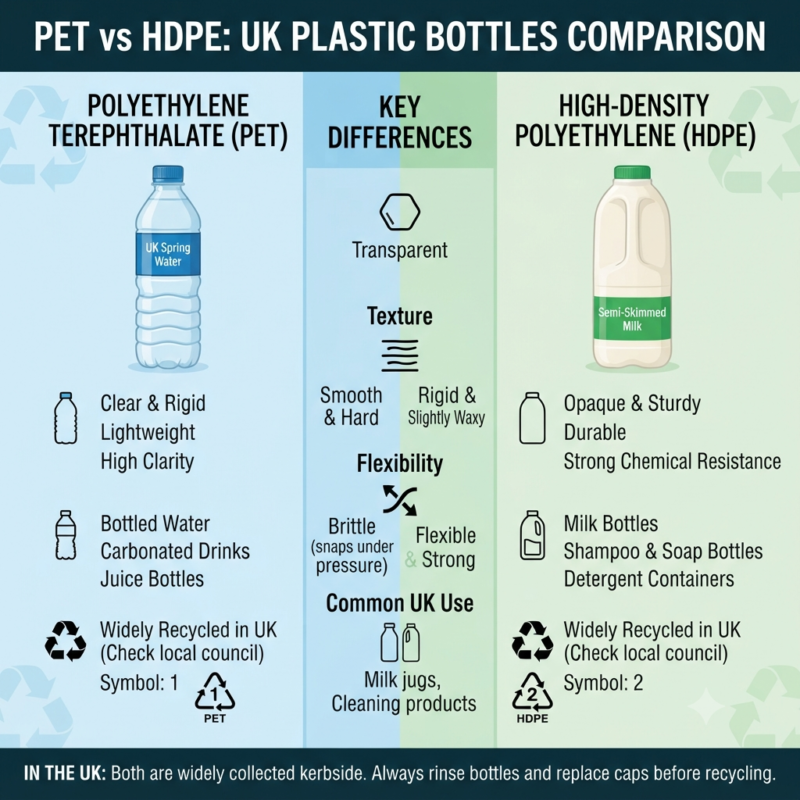
PET is a thermoplastic polymer belonging to the polyester family. When processed into bottles, it is highly celebrated for its crystal-clear transparency, resembling glass but without the fragile weight. It is lightweight, exceptionally strong, and possesses high impact resistance. In the UK consumer market, PET is the go-to choice for soft drinks, water bottles, salad dressings, and premium cosmetics. It acts as an excellent barrier against oxygen and carbon dioxide, which is why it is preferred for carbonated beverages that need to retain their fizz.
When packing PET bottles for transit, companies generally look for lightweight yet secure outer casing. Utilizing high-quality custom packaging boxes uk ensures that these flawless, clear bottles do not get scratched, scuffed, or dented during distribution across nationwide retail networks.
What is HDPE (High-Density Polyethylene)?
HDPE is a petroleum-based thermoplastic known for its immense strength-to-density ratio. Unlike PET, HDPE has a long, linear polymer chain with minimal branching, which makes its structural makeup highly dense and rigid. Visually, HDPE is naturally translucent or opaque, offering a milky, matte finish that can be easily dyed into vibrant solid colours like bright white, deep blues, or rich blacks. It is highly resistant to a vast range of chemicals, acids, and caustic solutions, making it the gold standard for milk jugs, shampoo bottles, bleach, household cleaners, and industrial motor oils.
Because HDPE bottles are typically more rigid and carry heavier, more chemically reactive liquids, they require rugged secondary transit containers. Many industrial supply firms pair these bottles with heavy-duty custom cardboard boxes uk to withstand the high weight stacks in regional distribution warehouses.
What Is the Difference Between PET and HDPE Plastic Bottles UK? A Structural Comparison
To give you an immediate, comprehensive overview of how these two materials stack up against one another, let us look at their physical and chemical attributes side by side.
Table 1: Material and Physical Property Breakdown
| Feature | PET (Polyethylene Terephthalate) | HDPE (High-Density Polyethylene) |
| Recycling Code | Resin Code 1 | Resin Code 2 |
| Visual Appearance | Crystal clear, high gloss, transparent | Opaque or translucent, matte finish |
| Rigidity & Flexibility | Semi-rigid to rigid, high tensile strength | Highly rigid, tough, impact resistant |
| Chemical Resistance | Good for oils, alcohols, and dilute acids | Excellent for strong acids, alkalis, solvents |
| Gas Barrier Quality | High barrier against $O_2$ and $CO_2$ | Moderate gas barrier, high moisture barrier |
| Temperature Tolerance | Lower heat tolerance (up to approx. 60°C) | Higher heat tolerance (up to approx. 110°C) |
| Common UK Products | Soft drinks, premium cosmetics, juices | Milk, detergents, bleach, industrial fluids |
When analyzing what is the difference between PET and HDPE plastic bottles UK, businesses must evaluate how the physical traits influence retail appeal. A clear PET container allows the natural, vibrant colour of a fruit juice or a luxury bath oil to shine through on the store shelf. On the flip side, an opaque HDPE bottle hides the contents, which is ideal if you are selling industrial chemicals or value-tier household items where visual clarity is completely irrelevant.
Visual Aesthetics and Brand Presentation
The choice between a clear or opaque material completely alters your product’s visual identity on the shelf. For premium brands operating in the competitive high-street retail sectors of London, Manchester, or Edinburgh, aesthetics are everything.
Transparency vs. Opacity
PET behaves almost like a lightweight, shatterproof glass mirror for your liquid products. If your brand relies on visual purity—such as raw organic juices, clear face toners, or multi-coloured bath salts—PET is the clear winner. It communicates cleanliness, premium quality, and modern sophistication.
However, if you are designing items that need protection from direct light degradation, or if the liquid inside is chemically intense and aesthetically unappealing, HDPE provides the perfect opaque mask. You can easily colour-match HDPE bottles to fit your corporate identity, using solid primary shades to stand out in the crowded household cleaning aisles.
Outer Packaging Alignment
No matter which bottle style you choose, its premium look must be matched by its outer box. A beautiful clear PET bottle looks out of place if it arrives in a flimsy, generic mailing bag. Forward-thinking brands often pair their bespoke plastic containers with high-end product packaging uk solutions. For instance, if you are shipping a high-end shampoo line housed in matte white HDPE bottles, setting them inside custom printed boxes uk creates a cohesive brand experience that commands attention from the moment the courier hands over the parcel.
Chemical Compatibility and Product Safety
One of the most critical aspects of exploring what is the difference between PET and HDPE plastic bottles UK centers around chemical compatibility. Packing a formulation into the wrong type of plastic can result in catastrophic product degradation, container paneling (where the bottle collapses inward), or chemical leaching.
[Product Chemical Makeup]
          │
          ├── Is it an Acid, Alkali, or Heavy Solvent? ──► Choose HDPE (Resin 2)
          │
          └── Is it Carbonated, Essential-Oil Based, or Clear? ──► Choose PET (Resin 1)
When to Pick PET for Safety
PET is outstandingly stable when holding diluted essential oils, alcohol-based perfumes, household flavorings, and non-corrosive liquids. Because it acts as an aggressive barrier to gases, it prevents outside oxygen from seeping into the bottle and oxidizing your ingredients. This preserves the shelf life of vitamins, natural oils, and food products. It also prevents carbon dioxide from escaping, meaning your sparkling beverages will stay carbonated for months.
When HDPE is Unbeatable
If your product line contains aggressive active chemical agents, heavy surfactants, essential oils in high concentrations, or corrosive acids, HDPE is your ultimate shield. HDPE has an incredibly low reactivity rate. It is impervious to the caustic ingredients found in heavy-duty toilet cleaners, garden pesticides, car maintenance fluids, and industrial solvents. If you were to put heavy industrial bleach into a standard PET bottle, over time the plastic would weaken, turn brittle, and potentially breach.
For companies specializing in industrial components, electronics, or specialized chemical kits, the primary bottle is only half the battle. Delivering these items safely through the domestic postal system requires robust custom shipping boxes uk crafted by experienced packaging manufacturers like CustomBoxes Azz to guarantee that any accidental micro-leaks are fully contained.
Temperature Resistance and Manufacturing Processing
The thermal properties of PET and HDPE dictate how your bottles can be filled along the production line. If your manufacturing setup involves hot-filling liquids, this factor alone could make your decision for you.
The Hot-Fill Dilemma
PET has a relatively low glass transition temperature. If you attempt to pour a liquid heated above 60°C to 65°C into a standard PET bottle, the structure will soften, warp, distort, and completely lose its shape. While there are specialized heat-set PET bottles available on the UK market, they come with a significantly higher price tag.
HDPE, by contrast, handles heat like a champion. With a melting point hovering around 120°C to 130°C, HDPE bottles can comfortably endure commercial hot-filling processes up to 85°C to 90°C. This makes HDPE a fantastic candidate for certain food sauces, syrups, and industrial mixtures that must be bottled at high temperatures to ensure sterile conditions.
UK Recycling Standards and Environmental Sustainability
With the UK government aggressively pushing toward a circular economy via the Plastic Packaging Tax and strict extended producer responsibility (EPR) schemes, sustainability is at the forefront of every brand’s logistical planning. When analyzing what is the difference between PET and HDPE plastic bottles UK, you must consider how each material performs at municipal recycling centers across the country.
Table 2: Environmental and Recycling Processing Metrics
| Environmental Factor | PET (Resin 1) | HDPE (Resin 2) |
| UK Kerbside Collection Rate | Nearly 100% across all UK councils | Virtually 100% across all UK councils |
| Recycled Form Name | rPET | rHDPE |
| Downcycling Potential | Can be recycled back into food-grade bottles repeatedly | Often downcycled into pipes, plastic lumber, or bins |
| Carbon Footprint Impact | Highly optimized lightweight transport profile | Slightly heavier, but highly durable for multi-use |
Both PET and HDPE are stellar performers in the UK recycling infrastructure. Because both are widely accepted by every local council from Cornwall to the Scottish Highlands, your customers will face zero confusion when discarding empty packaging into their domestic recycling bins.
The Rise of rPET and rHDPE
To avoid the UK’s steep plastic packaging taxes, many modern brands are shifting directly to rPET (recycled PET) and rHDPE (recycled HDPE). These materials utilize post-consumer waste, lowering the demand for virgin crude oil extraction.
When you align your brand with sustainable plastic bottles, it is highly recommended to extend that environmental narrative to your secondary casing. Moving away from standard plastic bubble wrap and instead using biodegradable cardboard boxes uk sends a clear message to eco-conscious British consumers that your business takes environmental stewardship seriously.
Weight, Shipping Efficiency, and Logistics
Shipping costs in the UK are calculated based on both dead weight and volumetric dimensions. Choosing between PET and HDPE can subtlely alter your freight bills over a long fiscal year.
Structural Weight Variables
PET bottles are engineered to be extremely thin-walled yet structurally resilient against interior pressures. This lightweight nature means you can pack thousands of filled units onto a delivery pallet without instantly hitting the maximum weight capacity of a standard delivery lorry.
HDPE bottles are typically blown with thicker walls to provide that signature rigid feel and crush resistance. While a single bottle difference is negligible, shipping 50,000 units of HDPE containers vs 50,000 units of PET containers can result in a noticeable weight variance, impacting your distribution costs.
Maximizing Pallet Density with Custom Boxes
To offset any logistical weight penalties, optimizing your outer box dimensions is paramount. If you pack your bottles into oversized, standard boxes, you are essentially paying to ship empty air across the UK road network. Working with CustomBoxes Azz allows you to design custom size boxes uk that perfectly match the contours of your PET or HDPE bottles. This eliminating internal movement, prevents scuffing, and maximizes the number of products you can securely stack onto a single transit pallet.
Industry-Specific Applications: Who Uses What?
To make this practical, let us look at how different commercial sectors throughout the UK divide their loyalty between PET and HDPE containers.
The Beverage Sector
Walk down any aisle in a British supermarket like Tesco, Sainsbury’s, or M&S, and you will see that PET absolutely rules the cold beverage industry. Carbonated sodas, tonic waters, mixers, and mineral waters are almost exclusively housed in PET because it traps the carbonation. Opaque HDPE is relegated mostly to the dairy aisle for fresh milk, milkshakes, and cream pots, where light protection helps slow down spoilage.
If you run a boutique drink brand or a gourmet takeaway service, you might also be handling home delivery options. Combining your custom-shaped juice bottles with secure custom postal boxes uk ensures your bottles arrive unpunched and chilled without any structural failures during local transit.
Cosmetics, Beauty, and Personal Care
The personal care market uses both materials heavily, splitting them based on formulation type and luxury tiering.
- High-end serums, micellar waters, body mists, and luxury bath oils utilize clear PET to project a high-value, glass-like aesthetic.
- Creamy body lotions, everyday hair shampoos, deep conditioners, and foaming hand washes rely on HDPE because it is easy to squeeze and resists the degradation caused by soapy ingredients.
       [Cosmetics Brand Strategy]
                   │
         ┌─────────┴─────────┐
         ▼                   ▼
   [Premium Line]     [Everyday Line]
     Clear PET          Matte HDPE
  Luxury Aesthetic     Easy Squeeze
         │                   │
         ▼                   ▼
 [Magnetic Gift Box]   [Printed Mailer]
For premium retail lines, the unboxing presentation can make or break your customer retention rates. Packaging a clear PET bottle inside Custom magnetic closure boxes or a beautifully debossed custom gift box uk turns a simple beauty product into a sensory luxury gift experience.
Food and Specialty Condiments
In the food industry, PET is frequently chosen for clear honey jars, squeezy ketchup bottles, mayonnaise containers, and spice shakers. Its clarity allows consumers to inspect the food quality before making a purchase. However, for items like bulk cooking oils, vinegar blends, or heat-processed syrups, HDPE is widely adopted due to its thermal resilience and structural stability.
Food startups aiming for a professional presentation often complement their bottles with custom outer containers. If your business focuses on high-street fast food or premium takeaways, pairing your sauces with structural bespoke food packaging uk or branded custom pizza boxes uk helps build a highly recognizable local brand identity.
Financial Analysis: Cost of Sourcing PET vs. HDPE in the UK
When budgeting for a massive product rollout, material costs will heavily influence your final decision. Sourcing empty containers in bulk requires balancing initial plastic molding costs against the lifetime value and durability of the packaging.
Tooling and Manufacturing Expenses
PET bottles are typically produced using an injection stretch blow molding process. This involves creating a dense “preform” which is then reheated and stretched inside a mold using high-pressure air. The machinery and tooling costs for PET can be relatively high, meaning it is most cost-effective when run at high-volume production scales.
HDPE bottles are generally manufactured using extrusion blow molding. In this process, a molten tube of plastic (a parison) is dropped into a mold and blown out to the edges. This manufacturing style allows for highly intricate shapes, integrated handles (like those seen on milk jugs or detergent bottles), and lower initial tooling costs, making it accessible for mid-scale and small business operations.
Table 3: Economic and Operational Considerations
| Commercial Metric | PET Bottles | HDPE Bottles |
| Initial Tooling Cost | Higher up-front investment | Generally lower and more versatile |
| Minimum Order Quantities (MOQ) | Typically higher for custom shapes | Often lower and more flexible |
| Labeling Compatibility | Excellent adhesion for glossy clear labels | Requires careful adhesive choice due to matte texture |
| Design Flexibility | Great for smooth, sleek, ergonomic shapes | Exceptional for integrated handles and molded grips |
To keep overall product costs down, small business owners must optimize every single component of their supply chain. Sourcing bottles is just one step; acquiring outer transit materials at competitive prices is equally critical. Savvy entrepreneurs regularly buy gift boxes wholesale UK or order their shipping stock in bulk to keep their margins safe from inflation.
Protecting Your Bottled Products with Custom Secondary Packaging
No matter which material wins the debate for your specific liquid formulation, neither PET nor HDPE is entirely immune to the rough handling that occurs within regional courier networks. A heavy drop can crack a rigid HDPE cap, while a sharp object can pierce or scuff a pristine clear PET bottle. This makes your choice of secondary outer packaging incredibly critical.
The Role of Corrugated Material
For heavy liquids—such as a 5-litre container of car shampoo or a multi-pack of cold-brewed coffees—relying on standard single-wall cardboard is a recipe for disaster. You need a structural casing that absorbs external shock waves. Utilizing double-wall custom corrugated boxes uk provides a cushioned buffer zone that shields your plastic bottles from crushing forces when boxes are stacked high inside distribution vans.
Branding the Exterior
Your outer box is the very first physical point of contact your customer has with your business. In an era dominated by social media unboxing videos, an unbranded brown box is a massive missed marketing opportunity. By imprinting your brand colors, tagline, and social media handles onto custom boxes with logo uk, you elevate a simple delivery into a professional brand statement.
Whether you are distributing delicate e-liquids housed in specialty small plastic bottles or selling artisanal lifestyle items, using tailored options like custom mailer boxes uk or custom printed postal boxes uk ensures your products stay safe while creating a memorable impression from the moment the delivery arrives.
Final Strategy: Making the Right Business Choice
When finalizing your brand strategy and answering the core question—what is the difference between PET and HDPE plastic bottles UK—the answer ultimately depends on your product’s unique formulation, your brand identity, and your manufacturing workflows.
Choose PET if:
- Your product requires a high-end, glass-like aesthetic with crystal clarity.
- You are bottling carbonated drinks, juices, or items sensitive to oxygen exposure.
- You want a lightweight container that highlights the natural colour of your liquid contents.
Choose HDPE if:
- Your formulation contains harsh chemicals, heavy oils, or acidic compounds.
- You require a hot-fill manufacturing process where temperatures exceed 60°C.
- Your product benefits from a solid, opaque, brightly coloured bottle with an integrated carrying handle or a easy-to-squeeze structure.
Once your primary bottle choice is locked in, ensure your outer shipping workflow is completely optimized by collaborating with an expert UK packaging team like CustomBoxes Azz. From matching your bottle geometry with custom inserts to crafting sturdy bespoke packaging uk solutions, having the right combination of primary plastics and premium outer cardboard guarantees that your products will stand out on the shelves and arrive safely at your customers’ doorsteps every single time.
Request a Quote
Advanced Engineering Aspects: Barrier Properties and Shelf-Life Stability
When exploring what is the difference between PET and HDPE plastic bottles UK, looking at surface aesthetics is only the beginning. For product developers, chemical engineers, and logistics managers across the UK, the true test of a plastic container lies in its microscopic barrier properties. Every polymer has a unique molecular matrix that determines how well it keeps gases, moisture, and light from migrating through the container walls.
If these barrier elements are mismatched with your liquid product, you risk a short shelf life, flavor degradation, or a complete structural failure of the bottle.
Gas Permeability: Oxygen and Carbon Dioxide Barriers
One of the most profound scientific contrasts between these two materials is their permeability to gases. PET features an incredibly tight, dense crystalline structure that acts as a fortress against gas migration. It is highly effective at stopping oxygen ($O_2$) from entering the bottle and prevents carbon dioxide ($CO_2$) from escaping.
- PET Performance: Because it holds carbonation so effectively, it is universally used for sparkling water, carbonated soft drinks, and premium beer lines throughout the UK. Keeping oxygen out also prevents the oxidation of delicate compounds, which is why raw juices or vitamin-infused health shots stay fresh in PET for much longer without losing their nutritional potency or changing taste profiles.
- HDPE Performance: HDPE has a completely different molecular chain arrangement. While it is incredibly tough, its gas barrier properties are significantly lower than PET. Oxygen can slowly seep through the walls of an HDPE bottle over an extended period, and carbon dioxide will escape relatively quickly. If you attempt to bottle a carbonated beverage in an HDPE container, it will lose its carbonation and go flat within a matter of days.
Moisture Vapor Transmission Rate (MVTR)
While PET wins the battle against gases, HDPE dominates when it comes to blocking moisture and water vapor. The high density of HDPE creates an exceptional moisture barrier that prevents water from evaporating out of the container or external humidity from altering the contents inside.
This makes HDPE highly sought after for concentrated household products, dry powders that must not clump, and industrial agrochemicals. If you are shipping highly concentrated liquid items that must maintain an exact water-to-chemical ratio over a multi-year shelf life, HDPE is the standard engineering choice.
Secondary Packaging Integration: Crafting the Perfect Shipping System
No matter how advanced your primary PET or HDPE bottle is, it cannot sit loose on a delivery truck or warehouse pallet. It must be integrated into a smart, well-engineered secondary packaging system. For e-commerce businesses and commercial manufacturers operating out of UK transport hubs like Birmingham, Manchester, or Leeds, selecting the right outer container is essential for protecting your bottom line.
Protecting Clear PET from Surface Defacing
Because PET is crystal clear and highly polished, it is prone to surface scratching and scuffing if bottles rub against each other during transit. If a premium cosmetic or cold-pressed juice bottle arrives on a store shelf looking cloudy, scuffed, or worn out from friction, its retail value plummets.
To prevent this, brands use tailored outer options. Placing your clear bottles inside high-quality custom cardboard packaging uk or utilizing internal cardboard dividers creates a protective barrier for each individual unit. Many high-end e-commerce health and beauty brands select custom branded gift boxes uk to elevate the luxury feel, ensuring the clear plastic arrives in pristine, mirror-like condition.
Supporting Heavy-Duty HDPE Containers
On the other side of the spectrum, HDPE bottles are frequently used for bulk sizes, such as 1-litre, 2.5-litre, or 5-litre containers filled with heavy household detergents, vehicle oils, or garden chemicals. The sheer weight of these liquids means that standard retail boxes will simply buckle or tear under the pressure when stacked.
To handle this weight, businesses rely on heavy-duty cardboard uk configurations. Utilizing double-wall constructions, such as double wall cardboard boxes uk, provides the necessary compression strength to support heavy loads. These boxes can be stacked multiple tiers high on warehouse pallets without any risk of the bottom boxes collapsing and puncturing the plastic bottles underneath.
Sizing Guides, Dimensions, and Commercial Standards
Navigating standard retail and shipping dimensions is a crucial step when designing your product layout. When you are mapping out your inventory space or trying to calculate shipping costs with Royal Mail, DPD, or DHL, understanding bottle footprints and box dimensions is non-negotiable.
Table 4: Common UK Bottle Sizes and Recommended Box pairings
| Bottle Capacity | Typical Material | Common Industry Application | Recommended Secondary Packaging Type |
| 30ml – 100ml | PET | Travel toiletries, luxury facial serums, vape liquids | custom boxes packaging uk with inserts |
| 250ml – 500ml | PET / HDPE | Cold-pressed juices, craft sodas, shampoos, hand soaps | custom mailer boxes uk or printed postal boxes |
| 1 Litre | HDPE / PET | Dairy milks, specialized cleaning chemicals, hair salon sizes | Heavy-duty single wall cardboard boxes uk |
| 2.5 Litre – 5 Litre | HDPE | Industrial solvents, vehicle fluids, bulk catering oils | Reinforced double wall cardboard boxes uk |
Understanding Box Constraints
When choosing your outer shipping boxes, you must carefully calculate your box dimensions uk to prevent unnecessary product movement. If your boxes are even slightly too large, the bottles can slide around during bumpy transit routes, leading to dented caps, twisted pumps, or fluid leaks.
For boutique items or small product kits—such as a curated gift set featuring a 100ml PET toner bottle and cosmetic pads—designing the outer casing to mirror the precise business card size uk standard or custom micro-dimensions ensures a snug fit that eliminates the need for plastic bubble wrap or expensive void-fill materials.
[Pallet / Courier Van]
       └── [Double-Wall Corrugated Box] ◄── Maximum Stacking Strength
                 └── [Cardboard Dividers] ◄── Stops Bottle Friction
                           └── [PET / HDPE Bottles] ◄── Liquid Product Secure
Special Niche Sectors: Vaping, Pharmaceuticals, and Luxury Gifts
The debate of what is the difference between PET and HDPE plastic bottles UK spreads into several highly regulated niche sectors across the United Kingdom. These specialized fields have strict legal requirements regarding chemical leaching, child resistance, and tamper-evident packaging.
The Electronic Cigarette and Vape Industry
The UK vape industry is heavily regulated under the Tobacco Products Directive (TPD). E-liquids contain a mixture of vegetable glycerin, propylene glycol, flavorings, and nicotine. Because nicotine can degrade when exposed to light and oxygen, selecting the right plastic is paramount.
- Small 10ml e-liquid refills almost exclusively use rigid, clear PET or slightly squeezable PET because of its excellent gas barrier, which keeps the nicotine formula stable and potent.
- For the outer distribution of these delicate components, manufacturers turn to specialty options like dmt cart packaging uk or tailored vape display boxes. Using precise custom size boxes uk allows manufacturers to ship thousands of tiny e-liquid bottles securely to high-street vape shops across the country without risking any accidental punctures or cap failures.
The Luxury Gifting and Candle Market
Another fascinating cross-over happens in the premium lifestyle and home fragrance market. While candles themselves are housed in glass or tin, complementary home mists, linen sprays, and bath oils are frequently packaged in high-grade PET due to its premium glass-like clarity.
       [Home Fragrance Product Line]
                     │
         ┌───────────┴───────────┐
         ▼                       ▼
  [Linen Spray Mist]      [Luxury Candle]
   Clear PET Bottle        Glass Jar / Wax
         │                       │
         ▼                       ▼
  [Candle Boxes UK]       [Candle Gift Boxes]
When high-end hotels or boutique brands create gift sets, they don’t just throw these items into a standard brown shipping box. They combine their elegant PET spray bottles and wax items into dedicated candle boxes uk or rigid candle gift boxes. This multi-layered presentation creates an exceptional unboxing experience for the customer.
Sourcing, Logistics, and Procurement Strategy for UK Businesses
When you are responsible for purchasing packaging materials for a growing British enterprise, managing your cash flow while securing consistent, high-quality inventory is a fine art. Sourcing your primary bottles and your secondary boxes from reliable channels can save your business thousands of pounds annually.
Sourcing Bottles Safely
When ordering your PET or HDPE bottles, always request compatibility testing samples from your manufacturer. Fill the sample bottles with your actual liquid formulation and store them at various temperatures for several weeks. This step allows you to check for any signs of “paneling” (where a drop in internal pressure pulls the bottle walls inward) or chemical degradation before placing a massive bulk order.
Sourcing Secondary Packaging in Bulk
To keep your unit costs low, smart procurement managers look for wholesale opportunities for their outer casing. Whether you need to source specialized presentation boxes or find reliable ways to buy gift boxes wholesale UK, ordering your shipping supplies in larger quantities lowers your per-unit costs and protects your business from sudden supply chain shortages.
Working with established manufacturing hubs like CustomBoxes Azz allows you to design everything from robust custom shipping boxes uk to premium retail cartons in one seamless workflow. This ensures that your outer packaging perfectly complements the physical and chemical characteristics of your chosen PET or HDPE bottles.
Checklist: Choosing Your Ideal Plastic Bottle Material
To conclude your strategy session, run your liquid product line through this practical decision matrix to ensure you are selecting the ideal material for your long-term business goals:
- Is your liquid carbonated or highly sensitive to oxidation?
- Yes: Choose PET to lock in gases and protect against oxygen.
- Does your product line feature bright, natural colors that visually drive consumer sales?
- Yes: Choose PET for its crystal-clear transparency.
- Is your formulation highly acidic, caustic, or filled with heavy industrial chemicals?
- Yes: Choose HDPE for its outstanding chemical resistance and low reactivity.
- Does your production process require filling liquids at temperatures above 65°C?
- Yes: Choose HDPE to avoid thermal warping and deformation.
- Will your bottles be shipped through rough courier networks or nationwide mail systems?
- Yes: Pair either material with high-durability custom postal boxes uk and rugged custom corrugated boxes uk to eliminate transit damage.
By closely aligning your primary plastic properties with tailored secondary packaging solutions, your brand will minimize product waste, lower distribution costs, and deliver a polished, professional presentation that keeps your UK customer base coming back for more.
What is the primary difference between PET and HDPE plastic for my small business?
When you are choosing materials for your product, the main difference lies in the physical properties of the plastic. PET (Polyethylene Terephthalate) is known for its incredible clarity and glossy finish, which makes it perfect if you want your product to be visible, such as in food boxes. On the other hand, HDPE (High-Density Polyethylene) is more rigid, opaque, and highly resistant to chemicals, making it the go-to choice for soaps or industrial liquids. If you are struggling to decide, you might want to look into how your choice affects your secondary custom packaging uk. A clear PET bottle often looks great in custom boxes uk, while an opaque HDPE bottle might pair better with bespoke boxes uk. Always consider the aesthetic you want for your brand before settling on the material type.
Which plastic bottle is better for food packaging in the UK?
For food items, PET is generally the industry favourite because it is crystal clear, lightweight, and effectively keeps oxygen out, which helps maintain the freshness of your goods. If you are selling sauces or dressings, PET displays the colour and quality of your product perfectly. However, if your food product requires a heavier, more durable container, HDPE is a safer bet. No matter which one you choose, you must ensure your custom food packaging boxes with logo uk are designed to hold the specific weight of your bottles. Protecting your inventory during delivery is essential, so pairing your bottles with custom delivery boxes uk will ensure that your customers receive their items in perfect condition. Always check food-grade certifications before you place your bulk order.
Can I recycle both PET and HDPE bottles in the UK?
Yes, absolutely! Both PET and HDPE are widely accepted in household and commercial recycling streams across the country. This is a massive selling point for your brand. When you market your products, you can highlight that your bottles are sustainable, which really resonates with modern shoppers. To make your brand even more eco-friendly, you should consider using packaging for small businesses uk that is also recyclable. For instance, putting your recyclable bottles inside custom cardboard boxes uk creates a consistent message of environmental responsibility. If you need help sourcing boxes that match the dimensions of your recyclable bottles, feel free to contact us for custom size cardboard boxes near me so your logistics remain efficient and waste-free.
Which plastic type is more durable for shipping?
If you are worried about your bottles cracking during transit, HDPE is your best friend. It is much tougher, more impact-resistant, and less prone to shattering compared to PET. If you are shipping liquids long distances, HDPE provides that extra layer of safety. However, even the toughest bottles need proper support inside your shipping boxes. You should always pair your bottle selection with custom packaging boxes uk that have protective inserts. If you are using PET bottles, you must be extra careful, so I recommend using corrugated boxes for added structural support. This combined strategy ensures that your products stay secure, whether you are using a local courier or shipping across the country to your customers.
How do I choose between clear and opaque bottles for my brand?
This decision really depends on your product’s appearance. If you have a beautiful, vibrant product, you will want the high-clarity finish of PET, which lets your customers see exactly what they are buying. This is a classic tactic used by custom packaging uk experts to increase conversion rates. If your product is light-sensitive or you prefer a more minimalist, clinical look, HDPE is the perfect choice. Once you have picked your bottle type, your custom printed boxes uk will serve as your main branding space. You can use your custom boxes uk to explain the benefits of your product, while the clear bottle does the visual work. It is all about finding the right balance between visibility and protection.
Are there specific bottle shapes that are better for small businesses?
For small businesses, sticking to standard bottle shapes can save you a significant amount of money because you avoid the high costs of creating custom moulds. Most packaging companies in london uk will have a wide range of stock PET and HDPE shapes that work perfectly for various industries. When you use a standard shape, it is also much easier to find custom boxes uk that fit your product snugly. If you choose a unique, bespoke shape, you might have to invest in customised packaging boxes uk to match the bottle’s profile. I always suggest that my clients start with a high-quality stock bottle and focus their budget on premium branding and high-quality custom boxes packaging uk instead.
Can I use the same label design for both PET and HDPE bottles?
Not always. While the actual label design can be the same, the adhesive material you use might need to change. PET has a smooth, glossy surface that is very easy for most standard labels to stick to. HDPE, on the other hand, has a slightly lower surface energy, which can sometimes make certain adhesives struggle to stay on. Always tell your printer what material your bottle is made of before you order your labels. You can always get advice from packaging consulting in uk professionals who can ensure your labels stay pristine. Once the labels are applied, your bottles will look professional inside your custom packaging boxes uk, ready for you to ship out to your customers with confidence and style.
Do I need to worry about chemical compatibility?
Yes, chemical compatibility is crucial. If your product contains essential oils, harsh cleaning agents, or specific food ingredients, they might react with certain plastics. PET is generally resistant to mild acids and oils, but HDPE is much more robust when dealing with stronger chemicals or solvents. If you are unsure, you should request a sample bottle and do a stress test. You can keep your test samples organised in custom storage boxes uk while you monitor them. Safety is the number one priority, so make sure your custom boxes uk are also appropriate for the weight and type of liquid you are storing inside them to prevent any accidental leakage during your transit phase.
How can I improve my unboxing experience with these bottles?
The unboxing experience is what turns a one-time buyer into a repeat customer. Even if you use standard PET or HDPE bottles, you can make them feel luxury by how you present them in your custom packaging uk. Using presentation boxes or adding a branded tissue paper layer can elevate a simple plastic bottle into a premium experience. When your customers open their custom mailing boxes uk, the care you put into the packaging reflects the quality of your product. If you are selling items like candles or perfumes, you might want to look into candle gift boxes to make the bottle feel like a gift rather than just a container. Attention to detail is everything in the competitive UK market.
Is it cheaper to order in bulk for small businesses?
Ordering in bulk is the fastest way to lower your per-unit costs, but you have to balance that against your current storage capacity. If you don’t have a large warehouse, you might find it difficult to store thousands of bottles at once. Many packaging companies in london uk offer tiered pricing, so you can start with a moderate amount and scale up as you grow. The same principle applies to your custom boxes uk. You can get better prices when you order your custom printed boxes uk in larger quantities. If you are just getting started, focus on a manageable volume that allows you to test your market without tying up all your capital in inventory that is sitting in your office.
